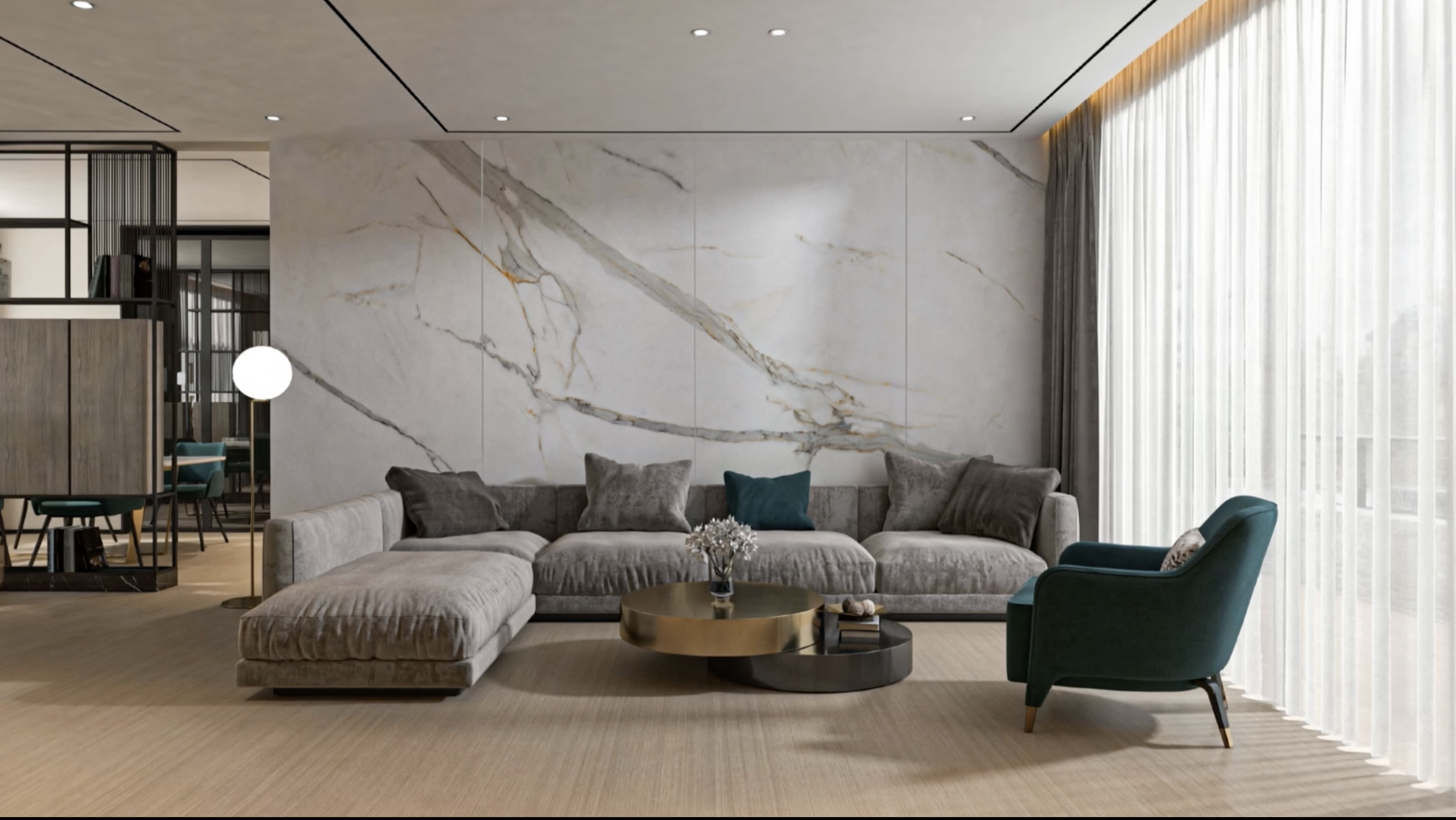
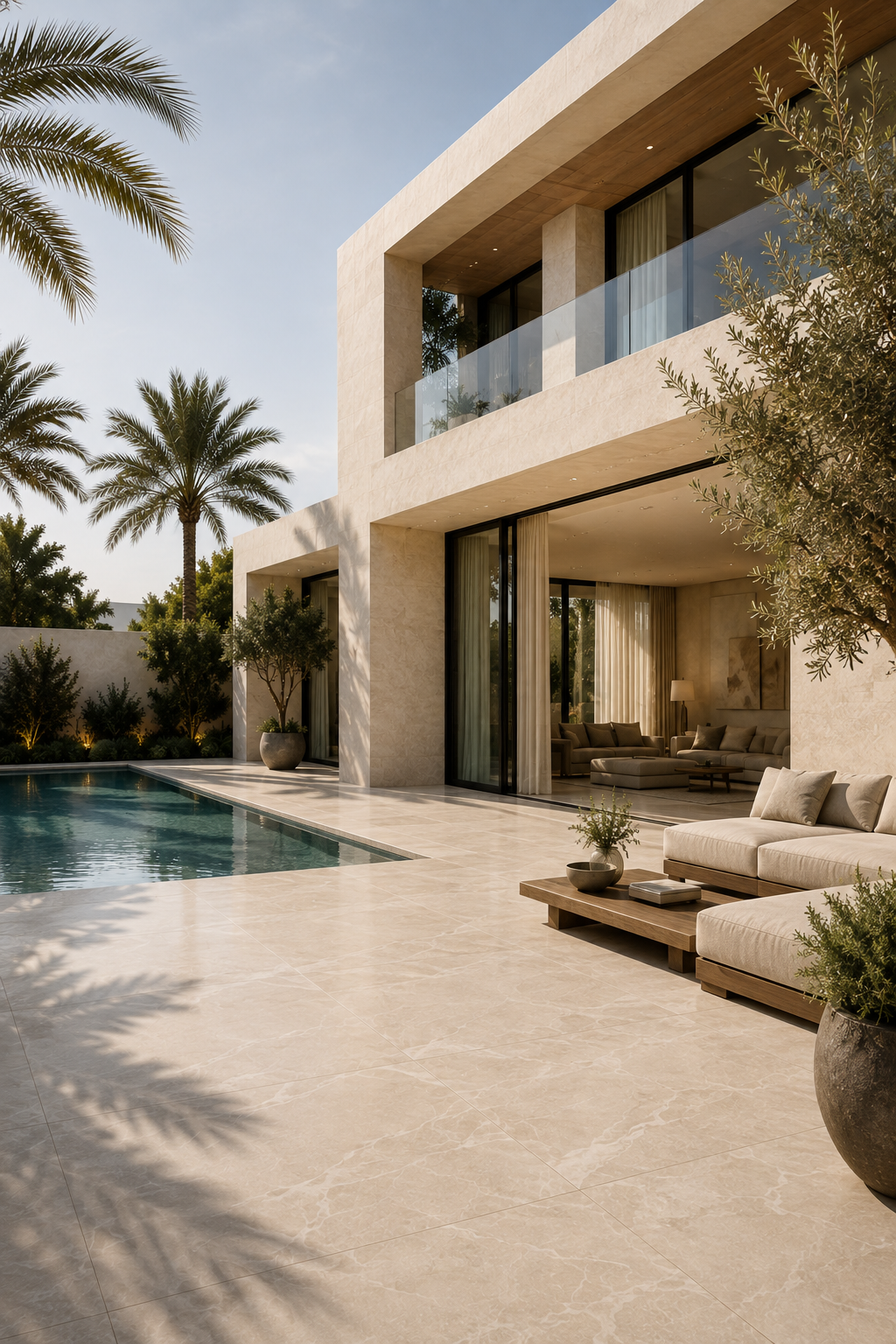
A villa is not one tiling decision. It is several dozen of them, made under one roof and expected to still make sense together a decade later. An apartment specification is usually solved room by room in isolation; a villa specification has to account for a majlis that opens visually onto a living room, a living room that opens onto a covered terrace, and a terrace that runs, without a change of level, into a pool deck. Whatever is chosen for one surface is seen from, and judged against, several others.
That scale changes what "choosing the right tile" actually means. It is rarely a single best material. It is a set of decisions — one per zone, coordinated across the whole property — where a floor's finish, format and technical rating all have to suit that particular room's traffic, moisture exposure and light, while still reading as part of one coherent home.
The question worth asking first
Reduced to appearance alone, tile selection becomes a colour choice. The more useful question — the one an architect, interior designer or experienced homeowner actually asks — is broader: what does this specific room demand technically, and does the product in front of me meet it, with documentation to prove it? Colour and finish follow from there, not the other way round.
This guide works through that question room by room and system by system: the UAE's climate as a design input rather than an afterthought; the travertine-look porcelain now appearing across a large share of new villa specifications, and what genuinely separates it from the natural stone it references; how to judge porcelain quality beyond the showroom sample; and a practical checklist for the conversation with a supplier before an order is placed.
This edition builds on "How to Choose the Right Tile for Every Space," Edition 06 of The Petrona Journal, which sets out the general mechanics of room-by-room tile selection — DCOF slip ratings, PEI abrasion classes, porcelain-versus-ceramic trade-offs. Rather than repeat that ground, this edition applies it specifically at villa scale, across a villa's indoor-outdoor threshold, and introduces the travertine-look porcelain trend in detail for the first time in the Journal. For a broader Abu Dhabi-wide buying guide — covering common sizes, finishes and realistic AED/m² price ranges across the market — see Edition 09, "Porcelain Tiles in Abu Dhabi."
Edition 05 of this Journal, "Best Building Materials for the UAE Climate," covers the underlying climate science in full — the region's Köppen classification, the WHO ultraviolet index, coastal humidity and the Shamal dust season, and the standards (ISO 13006, ANSI A137.1, ASTM C373) that measure how a material responds to them. That chapter applies to a villa exactly as it does to any building. What is specific to a villa is where those stresses concentrate: not on a single façade, but across a pool deck, an open terrace and a set of sliding thresholds that a family walks over barefoot, in direct sun, most of the year.
Surface temperature is the clearest example. A 2020–2022 University of Sharjah pilot study, conducted with the UAE Ministry of Energy and Infrastructure at a paved site in Sharjah, measured an uncoated exterior paving surface reaching approximately 60°C, against roughly 47°C for an equivalent surface finished with a high-reflectance (70% albedo) coating.1 The same physics apply to a pool deck: a darker, low-reflectance surface will run measurably hotter underfoot than a lighter one under the same midday sun — a genuinely practical reason, not merely an aesthetic one, that lighter, warm-toned porcelain has become the default recommendation for UAE pool surrounds and open terraces.
Uncoated Paving, Sharjah Pilot Study
Same Study, Same Conditions
Walk a tile showroom today against one from five years ago and the shift is immediate: the cool greys and stark whites that dominated the last decade have given ground to warm sand, cream and taupe tones, and a specific reference point recurs across nearly every major manufacturer's newest collection — travertine.
This is not a showroom impression alone. At Cersaie 2025, the world's largest ceramic tile fair, Infinity Surfaces launched a large-format line built specifically around vein-through travertine reproduction, and Panaria Ceramica extended an existing marble-effect collection with a dedicated travertine range.2 Coverings — the major North American tile and stone trade show — named "Mineral Drenching," the use of large porcelain panels to envelop a room in marble, onyx or travertine tones, and a parallel "Colors of Sand" palette trend spanning cream through golden beige, as defining directions for 2025.3 At Coverings 2026, the trend deepened rather than faded: new collections used advanced digital printing and structured surface texturing specifically to reproduce travertine's characteristic pitted, veined face at a level of realism not achievable a decade ago.4
Part of a wider palette shift
The travertine-look surface sits inside a broader move toward warm, understated neutral interiors — sometimes described commercially as "quiet luxury" — built on layered camel, sand and soft-white tones in place of high-contrast, high-gloss finishes.5 That shift is well documented in design and consumer-trend coverage; what is less commonly written down, and worth stating plainly here, is why it suits a UAE villa specifically. A warm stone tone reads as calm rather than clinical under strong natural light; it does not visually compete with the greenery, water and palm shadow that a villa's outdoor rooms are built around; and — unlike a genuinely white or pale grey floor — it does not show dust as readily in a climate where dust is a near-constant condition, not an occasional one.
Regionally, UAE-based porcelain manufacturers and suppliers have begun marketing dedicated travertine-inspired ranges to this market specifically, citing warm, earthy neutrals as a defining 2025 trend for local interiors.6 In Petrona's own Mussafah showroom conversations, this has been the single most consistent request across villa projects over the past year — architects and homeowners asking, specifically, for "the travertine look," almost always for a majlis, a living room, or a terrace intended to flow into the pool area beyond it, and increasingly for the wider Abu Dhabi villa market alongside Dubai.
"Travertine-look," "travertine-effect" and, commercially, "Travertine Print" are all used across the industry to describe the same category of product, and no ISO or ANSI standard formally defines the term — it is a manufacturer and retail naming convention, not a technical classification. European manufacturers tend to say "effect"; American and Gulf retail tends to say "look." This Journal uses "travertine-look porcelain" throughout, as the clearest term for a general readership, without implying any one phrasing is more technically correct than another.
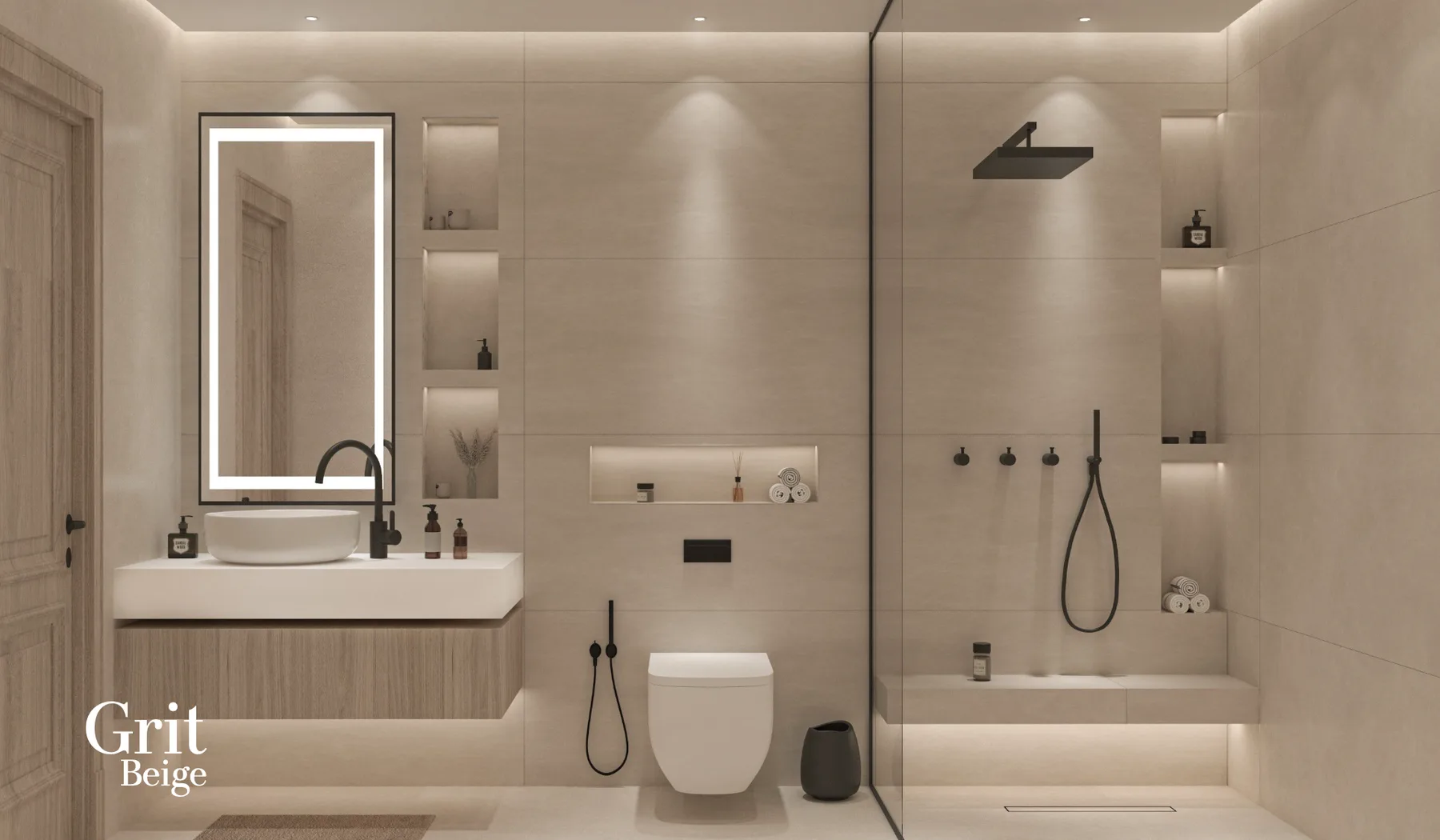
Natural travertine and its porcelain reproduction are not the same material
It is worth being precise here, because the two are easy to conflate and behave differently in practice. Natural travertine is a sedimentary rock formed by the precipitation of calcium carbonate from groundwater, most often near mineral springs — a geological process that leaves it with a naturally porous, cellular texture, typically 1–10% porosity depending on the quarry and finish.7 That porosity is exactly what gives natural travertine its characteristic pitted face; it is also why natural travertine generally requires sealing, and periodic resealing — commonly every two to three years outdoors, more often in constant-wet areas — to resist staining from oil, sunscreen and standing water, and why unfilled, tumbled finishes are typically preferred outdoors for their grip, since a filled or polished travertine face becomes noticeably more slip-prone when wet.8
Travertine-look porcelain is a different material entirely, reproducing that appearance through high-resolution digital inkjet printing — and, in the newest collections, structured 3D surface texturing — applied to a dense porcelain body before firing.9 The Tile Council of North America, which maintains the ANSI A137.1 tile standard, defines porcelain by a water absorption of 0.5% or less, tested to ASTM C373 — describing it as effectively non-porous, in direct contrast to natural travertine's inherent porosity.10 That single technical difference is the reason porcelain reproductions, rather than natural travertine itself, have become the practical choice for continuous indoor-to-outdoor flooring in a villa: the look carries across the threshold; the maintenance regime and the slip performance do not need to, because porcelain does not depend on an intact sealant layer to resist moisture the way natural stone does.
None of this means every travertine-look porcelain performs identically. Rectification, thickness, slip rating and format vary meaningfully between manufacturers and even between lines from the same manufacturer. The point of this comparison is the category-level distinction between the two materials — not a claim that one specific product outperforms another. That judgement belongs to the product's own technical data sheet, covered next.
“Travertine-look porcelain does not claim to be travertine. It claims to solve the problem travertine creates when it has to survive a UAE terrace.”Chapter III · The Travertine-Look Movement
A showroom sample answers one question — does this look right — and leaves several more unanswered. Edition 01 of this Journal already covers the fundamental porcelain-versus-ceramic distinction, centred on that same 0.5% water absorption threshold referenced above. Beyond that starting point, four further characteristics separate a well-specified porcelain floor from one that causes problems after installation.
Rectification
A rectified tile has its edges mechanically ground to precise, uniform dimensions after firing, rather than left with the slightly rounded "cushion edge" a tile has straight out of the kiln. Rectification is what makes the narrow, near-invisible grout lines associated with large-format, slab-like installations possible; an unrectified tile in the same format will need a visibly wider joint to disguise dimensional variation between pieces. If the design intent is a continuous, minimal-grout villa floor, confirm the specific product is rectified — not assumed to be because the format is large.
Shade variation
Porcelain and ceramic tile shade consistency is a formally classified characteristic under ANSI A137.1, graded V0 (very uniform) through V4 (substantial, deliberately random variation).11 This is worth knowing precisely because it is often assumed to be a marketing term when it is, in fact, a real classification a manufacturer's technical data sheet should state. A V0–V1 product gives the uniform, calm floor most villa living spaces call for; a V3–V4 product is a deliberate design choice, closer to natural stone's own variability, and better suited to a feature area than a full villa floor plate. Note this is distinct from the similarly-numbered V1–V4 convention used for natural stone shade variation, which traces to a different, non-ISO industry origin — the two scales are not interchangeable.
Calibre
Because clay shrinks unevenly during firing, tiles nominally the same size emerge from the kiln at very slightly different actual sizes. Manufacturers sort fired tiles into calibre bands accordingly, and a batch mixing calibres will show inconsistent joint widths or lippage once installed — a defect that becomes more visible, not less, at large format, where a fraction of a millimetre of size variation is magnified across a metre-plus tile. Order from a single calibre and, ideally, a single production batch for any villa area laid as one continuous floor.
Country of origin, briefly
One quality signal worth naming and then setting aside: where a tile is manufactured. Edition 02 of this Journal, "Italian, Spanish, Indian & UAE Porcelain: Does Country of Origin Really Matter?", covers this in depth and reaches a principle worth restating here in one line — country of origin alone is not a sufficient measure of quality. A manufacturing hub's reputation is a starting point for a conversation, not a substitute for the product's own technical data sheet.
Documentation, not assumption
Petrona's own quality position — covered in full in Edition 04 — rests on the principle that a supplier's documentation should be checked, not assumed. The same discipline applies to any individual product: this Journal does not state a slip-resistance rating, a rectification status or a certification for any single named Petrona product here, because that information is specific to each product and must come from its own technical data sheet. Ask for it before ordering. Section VIII of this guide sets out exactly what to ask.
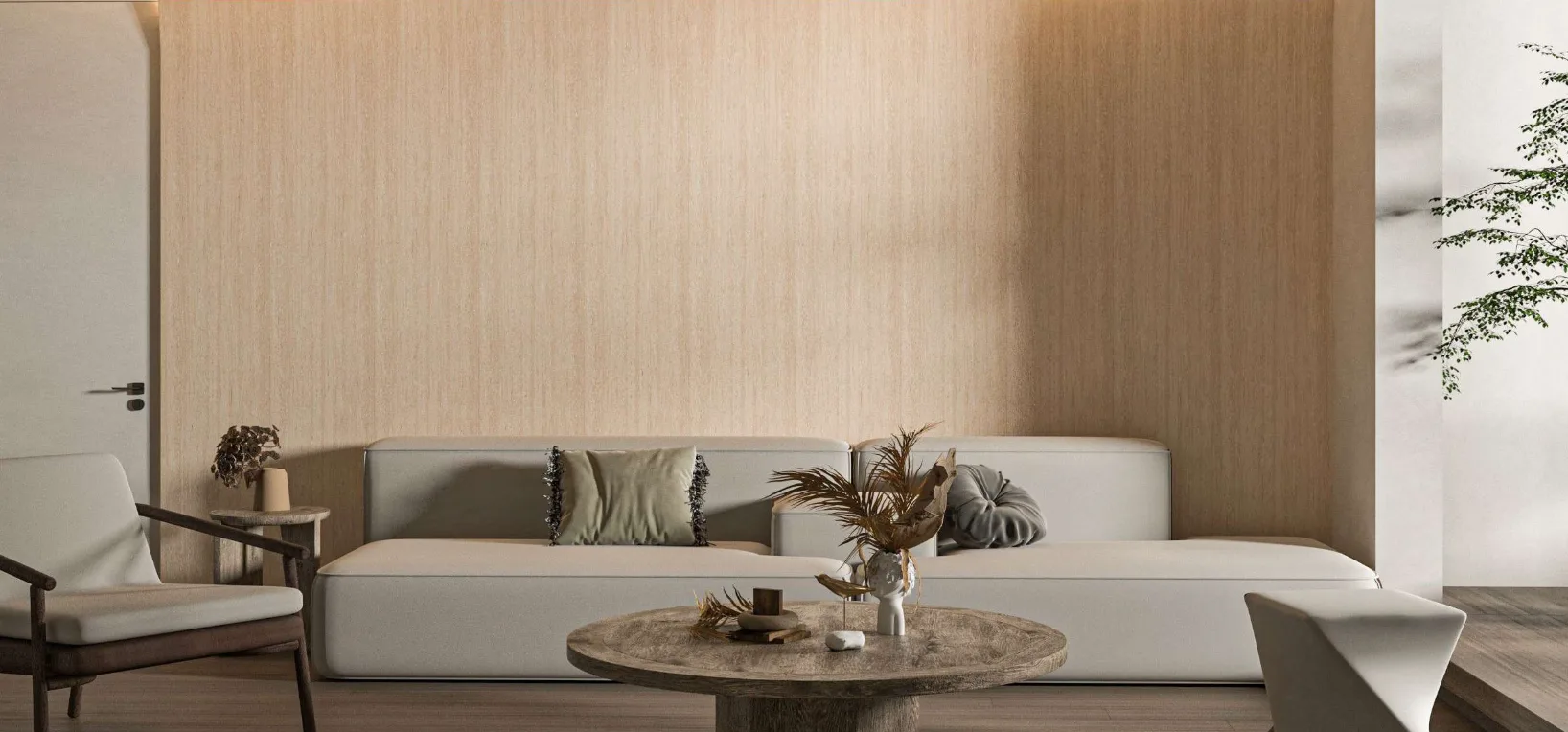
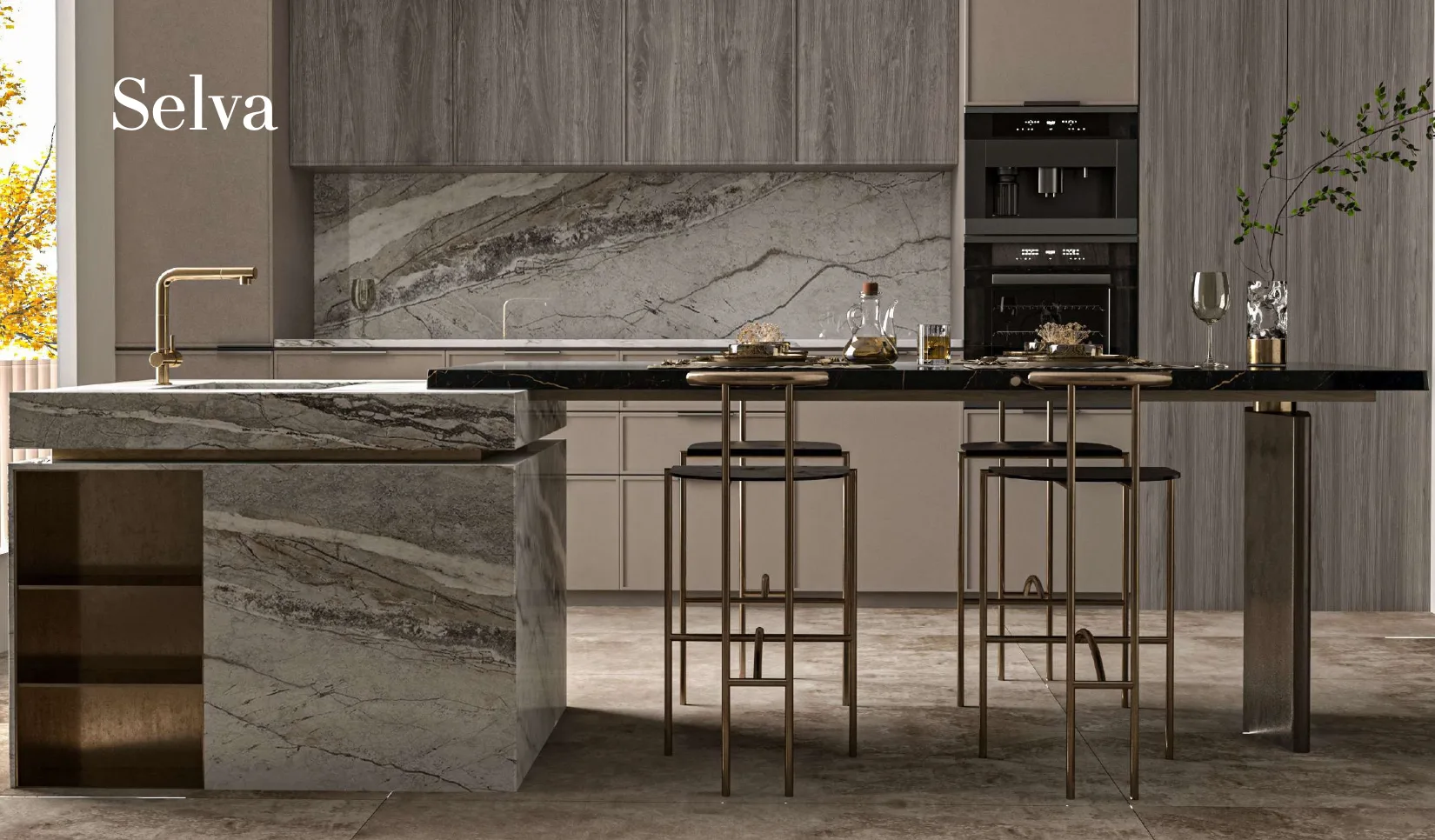
The technical mechanics of matching a tile to a room — DCOF and R-rating for slip, PEI class for abrasion resistance, the porcelain-versus-ceramic trade-off — are covered in depth in Edition 06. What follows is how those mechanics play out specifically across a villa's zones, where scale and sightlines between rooms raise the stakes on getting each one right.
Living rooms & majlis
These are usually a villa's largest continuous floor plates and its most visible reception spaces, which argues for large format, a rectified edge, and a low-to-moderate shade variation (V0–V1) for a calm, considered result under strong natural light. A matte or honed finish tends to suit a majlis better than high gloss, which can read as reflective and busy across a very large area rather than refined.
Entrances & foyers
The first indoor surface after the front door carries outdoor grit and higher foot traffic than almost any other indoor zone, which makes abrasion resistance (PEI class, per Edition 06) more relevant here than in a bedroom, even though the material itself may match the adjoining living space.
Kitchens
Staining resistance, ease of cleaning and a finish that hides daily marks matter more here than anywhere else indoors. Matte and satin finishes generally perform better than gloss for this reason, and grout width and sealant become a genuine maintenance consideration around cooking zones specifically.
Bedrooms
Traffic and moisture exposure are both lower, so the deciding factor is usually visual comfort — a warmer tone, or a wood-look or soft travertine-look finish, chosen for how a room feels rather than how it performs under stress.
Bathrooms
Matte does not automatically mean slip-resistant. What determines slip performance is a tested rating — DCOF under ANSI A326.3, or an R-rating under the DIN 51130 ramp test for barefoot wet areas — not the finish's appearance. Ask which standard a specific bathroom or wet-area product was tested to, and confirm the rating meets a wet-area benchmark, before assuming a matte surface is safe underfoot.
Staircases
The same slip-rating discipline applies here, with one addition: check the nosing or edge-profile detail available for the chosen format, since a stair tread carries a different risk profile from a flat floor even at an identical slip rating.
A UAE villa's outdoor rooms — the covered terrace, the pool deck, the entertaining area beyond it — are not a lesser extension of the indoor plan; for a large part of the year they are where the household actually lives. They also carry the heaviest technical burden of any zone in this guide: direct UV, surface heat approaching the figures cited in Chapter II, dust, and, around a pool specifically, near-constant moisture underfoot.
Colour is not purely aesthetic here. As Chapter II's Sharjah study data shows, a lighter, more reflective surface runs measurably cooler underfoot than a darker one in direct sun — a genuine practical argument, alongside the design case, for the warm-but-light tones typical of travertine-look porcelain on an exposed pool deck.
Slip performance around a pool deserves its own emphasis, beyond the bathroom guidance in Chapter V: a barefoot, wet, poolside condition is a more demanding test case than an indoor wet room, and the tested rating for that specific application — not the general product line's rating — is what should be checked. Façade cladding, including large-format 2cm-and-above gauged porcelain on raised or ventilated systems, is covered in full technical detail in Edition 03 of this Journal, "The New Façade: Large-Format Porcelain in Contemporary Architecture," which this guide does not repeat.
The clearest villa-design case for travertine-look porcelain, in fact, sits precisely at this indoor-outdoor threshold. A homeowner who wants a living room floor to run, visually uninterrupted, through a sliding door onto the terrace and out to the pool deck is asking for one consistent material across three very different exposure conditions. Natural travertine can technically do this, but its porosity makes a supplier reluctant to give the same confident guarantee outdoors as indoors. Porcelain, reproducing the same warm face at a consistent 0.5% or lower absorption throughout, removes that hesitation — provided, again, that the specific outdoor-rated product in the range is the one specified for the outdoor run, not simply the indoor product laid outside.
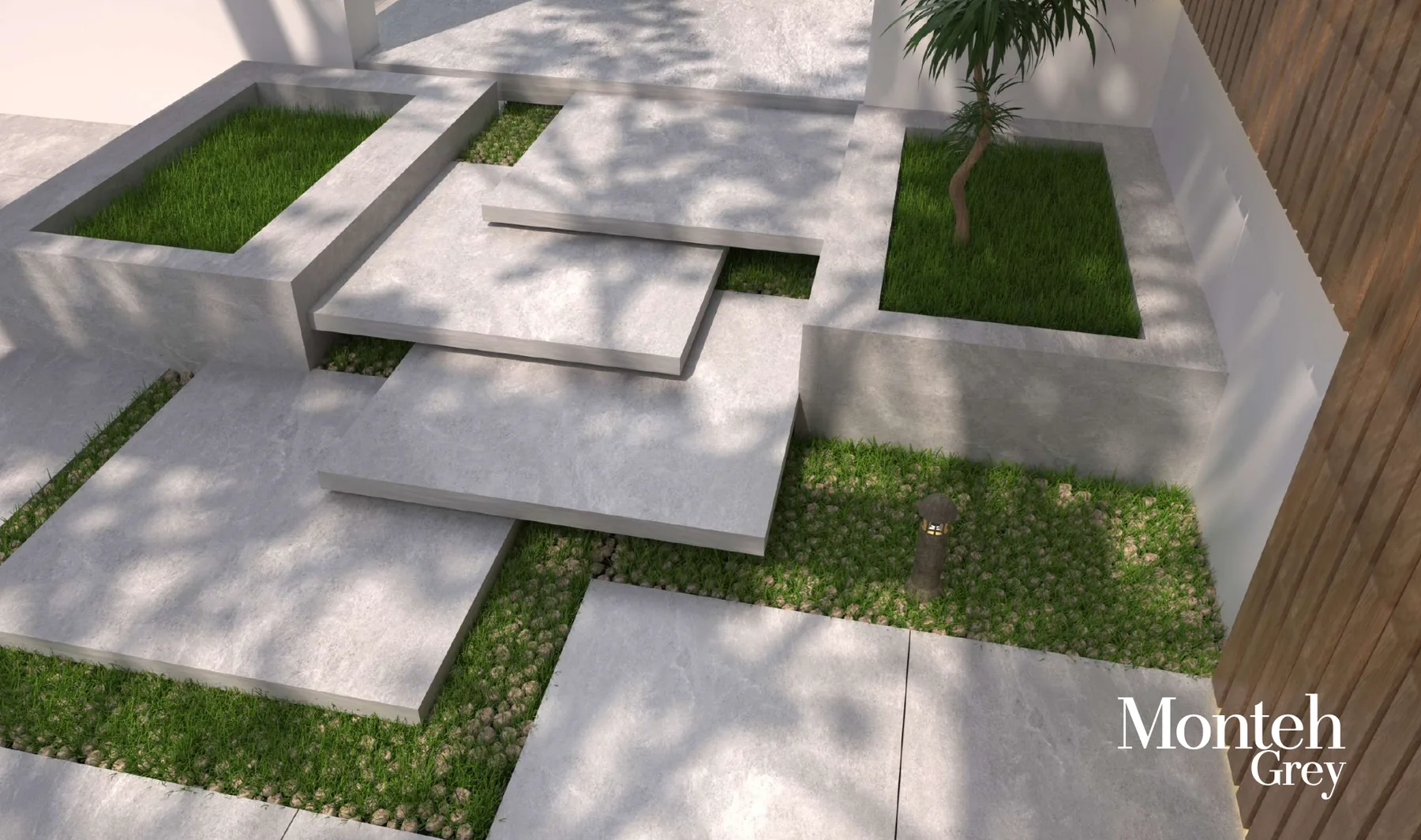
Format is an architectural decision as much as a material one. A 600×600mm tile reads as a floor made of tiles; a 600×1200mm or larger format, laid with minimal rectified joints, reads closer to a continuous surface — which is precisely the effect most large villa living spaces are specified to achieve. Petrona's own catalogued range spans this full spectrum: tile formats from 20×120cm to 120×120cm, large-format slabs from 120×240cm to 160×320cm, and dedicated outdoor formats from 60×60cm to 100×100cm at 20mm thickness for structural exterior use.
Larger is not automatically better, though it is often assumed to be. A larger format demands a flatter, more carefully prepared substrate, a more experienced installation crew, and typically produces more cutting wastage around stairs, niches and irregular room shapes — costs worth weighing against the visual payoff before committing an entire villa to one very large format. Smaller and mid-sized formats often remain the more practical choice for staircases, compact bathrooms and intricate layouts, even within a villa otherwise specified in large format elsewhere.
What to ask a porcelain supplier before ordering tiles for a villa — for a homeowner briefing an interior designer, or a professional preparing a specification, equally.
Is this specific product's technical data sheet available?
Water absorption group, and for any wet or outdoor application, a tested slip-resistance rating and the standard it was tested to.
Is the product rectified?
Confirm it matches the grout-line width the design intends — don't assume from format alone.
Is the required quantity available from one production batch?
Especially for a large, continuous villa floor plate, where a shade shift between batches is highly visible.
What should be allowed for cutting and wastage?
At this format, particularly around stairs, niches and pool coping details.
Is it worth holding back additional tiles for future repair?
Production runs can be discontinued or shift shade over time, making a like-for-like replacement difficult years later.
What does this format and thickness require for installation?
Substrate flatness, adhesive type, and movement joints for large-format or exterior applications.
What wet or outdoor performance data exists for this specific product?
Not the general product line — the exact item being ordered for that exact application.
Is a matching or coordinating finish available across indoor and outdoor ranges?
If continuous indoor-outdoor flooring is part of the design intent.
- University of Sharjah / UAE Ministry of Energy and Infrastructure, pilot study on coated pavement surfaces and the urban heat island effect, Zayed Educational Complex, Sharjah, 2020–2022 — reported via Global Infrastructure Hub.
- Interior Design magazine, "15 Standout Tile Designs Shaping Cersaie 2025," September 2025 — Infinity Surfaces "Travertino Trilogy," Panaria Ceramica "Perpetual/Travertino."
- Coverings (official North American tile & stone trade show), 2025 Tile Trends coverage — "Mineral Drenching" and "Colors of Sand" trend designations.
- Interior Design magazine, "Top Tile Trends Spotted at Coverings 2026" — Wonder Porcelain "Ivorynn Stone," Naxos Ceramica "Petraluna," Pastorelli "Levante."
- Design and interiors trend coverage on 2025–2026 "quiet luxury" warm-neutral palettes (Jane at Home; Zeysey), cited as evidence of consumer/design-trend framing rather than architectural criticism.
- RAK Ceramics UAE, "Tile Trends 2025: What's Hot This Summer," company blog, 2025 — regional manufacturer commentary on warm, travertine-inspired tones as a UAE market trend.
- Britannica, "Travertine"; GeologyScience.com, "Travertine" — geological formation and porosity characteristics of natural travertine.
- Stone-industry and sealing-trade sources (Sealer Pro; Tez Marble) on natural travertine sealing requirements and finish-dependent slip behaviour — cited as trade consensus, not a laboratory standard.
- Tile Outlets of America, on digital inkjet printing in modern porcelain manufacture; Coverings 2026 coverage on structured 3D surface texturing (Wonder Porcelain "ink-sinking" technology).
- Tile Council of North America (TCNA), "Porcelain vs. Non-Porcelain" technical FAQ — 0.5% water absorption threshold and non-porous classification, ASTM C373.
- ANSI A137.1 (American National Standard for Ceramic Tile, maintained by TCNA) — V0–V4 shade-variation classification, corroborated via manufacturer technical data sheets (Daltile, Interceramic).
- ISO 13006 (Ceramic tiles — Definitions, classification, characteristics and marking), dimensional-tolerance framework referenced for rectification and calibre — clause-level detail sourced via secondary technical guides, not independently verified against the primary ISO text; see the Edition 08 source register for this caveat.
- See also Editions 01, 03, 04, 05 and 06 of The Petrona Journal, and the ANSI A326.3 DCOF wet-slip-resistance benchmark and PEI abrasion classification already cited therein.
- For the adhesive, grout and installation-system considerations behind a villa's terraces, pool decks and wet areas covered in this edition, see a later edition of this Journal on tile adhesives, grouts and what makes an installation last.