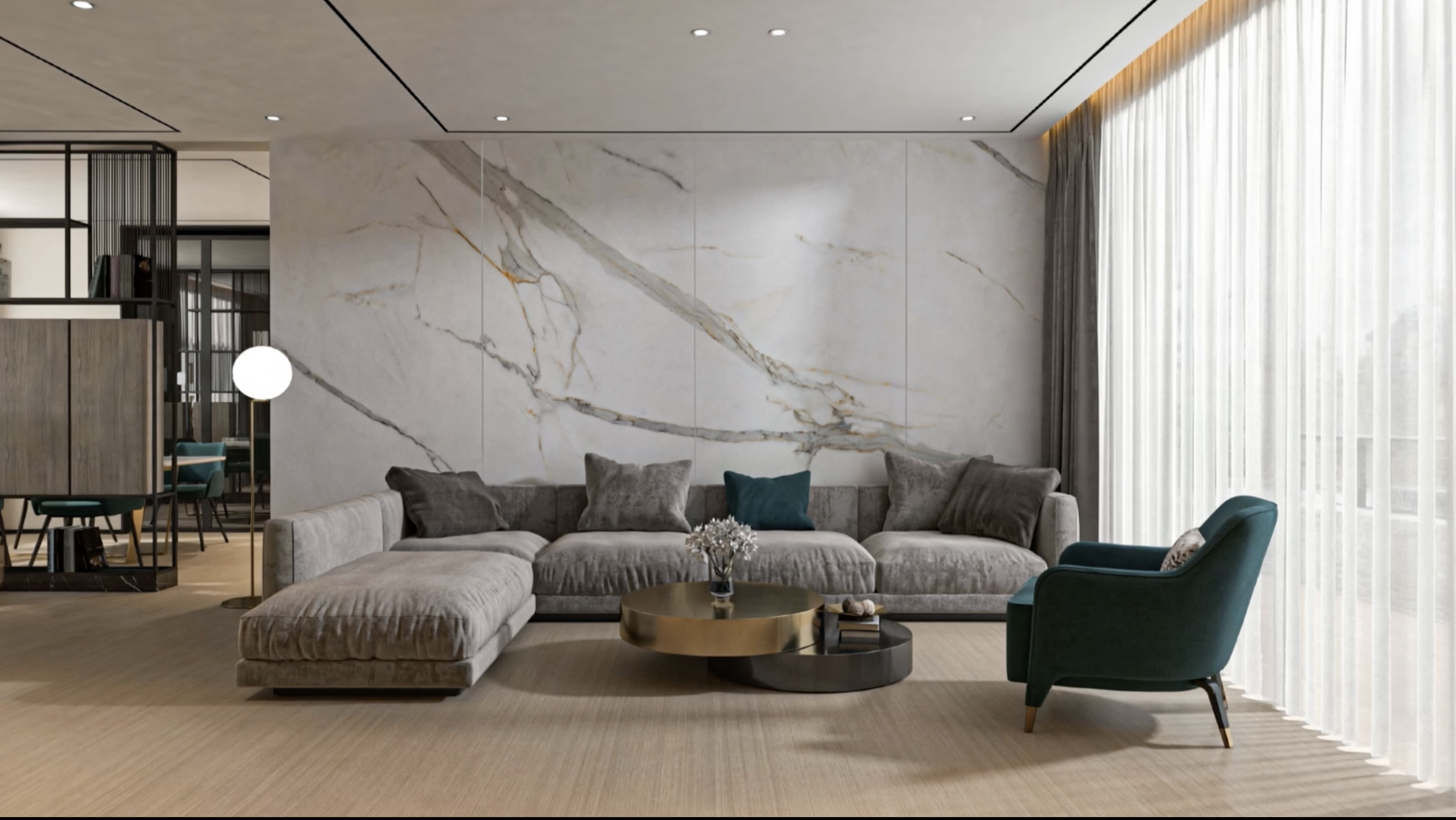
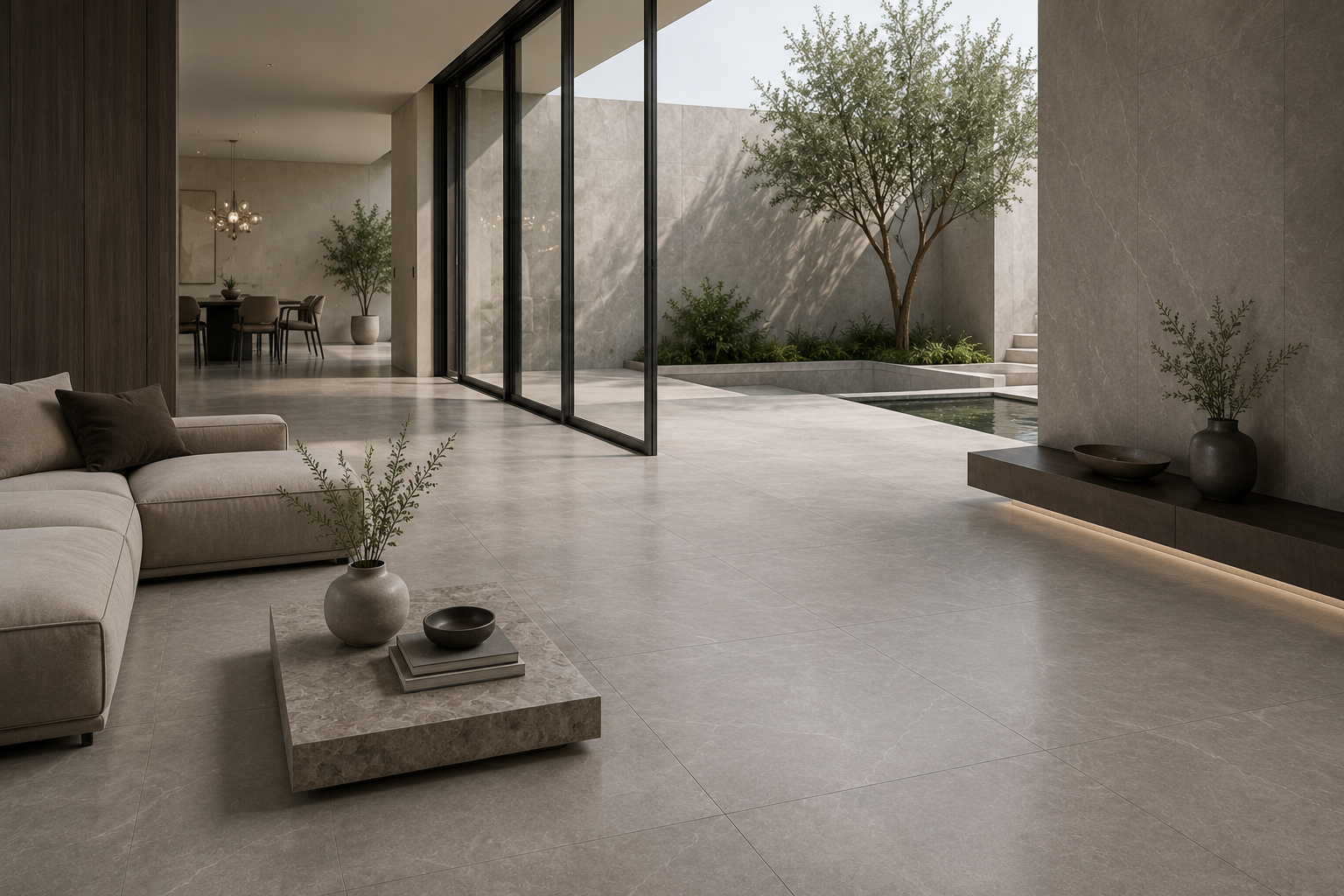
Walk into most new villas, apartments and commercial fit-outs across Abu Dhabi and the floor underfoot is, more often than not, porcelain. It has become the practical default for homes, offices, retail interiors and architectural projects across the emirate — not because it is the only option, but because it combines durability, low maintenance and design flexibility in a single material, at a scale of choice (sizes, finishes, surface designs) that few alternatives match.
This guide is written for anyone approaching a porcelain purchase in Abu Dhabi for the first time, or comparing options seriously for the first time: a homeowner planning a villa or apartment renovation, an interior designer briefing a client, or a contractor pricing a project. It covers what porcelain actually is, the sizes and finishes available, realistic price ranges in the current Abu Dhabi market, what "Grade A" means, the specifications worth checking before ordering, and what to look for in a supplier.
What is porcelain tile?
Porcelain is a dense, fine-grained ceramic tile fired at a higher temperature than standard ceramic, which gives it a water absorption of 0.5% or less under ISO 13006 and ANSI A137.1 — effectively non-porous. That single figure is what separates porcelain from ordinary ceramic tile, and it is why porcelain generally performs better for high-traffic floors, wet areas and outdoor use. Edition 01 of this Journal covers the full porcelain-versus-ceramic distinction — durability, cost and best-use comparisons — in depth; this guide assumes that starting point and moves straight into the practical questions a buyer actually faces in Abu Dhabi: size, finish, price and specification.
Porcelain is manufactured across a wide range of formats, and the Abu Dhabi market carries most of them. The most commonly specified sizes include:
600 × 600mm
The long-standing standard format for both residential and commercial floors. Easy to handle, widely stocked, and a practical choice for bathrooms, kitchens, staircases and smaller or irregularly shaped rooms where a larger format would produce more cutting wastage.
600 × 1200mm
Now the dominant format for open living spaces, majlis floors and commercial interiors seeking a more continuous, fewer-joint appearance. This size is used as the main illustrative format later in this guide's pricing section, since it spans the market's full range from entry-level to premium.
200 × 1200mm and other plank formats
A narrow, elongated format often used to reproduce a wood-look finish, or as a linear design element in feature walls and transitional zones.
Large-format tiles and slabs
At the upper end, porcelain is produced as large-format panels and slabs — commonly from around 120×240cm up to 160×320cm at roughly 9mm thickness — used for countertops, cladding, feature walls and façades. Edition 03 of this Journal covers large-format porcelain in architectural applications in full detail.
These formats are the ones most frequently encountered; they are not the only sizes manufactured, and a supplier's actual catalogue range should always be checked directly.
Finish and surface design are usually the first thing a buyer notices, and porcelain now offers more range on both fronts than at almost any point in the material's history.
Matte
A flat, non-reflective surface that suits large open areas and tends to hide daily marks and dust more readily than gloss. A matte finish is not automatically slip-resistant — that depends on the product's own tested rating, covered in Chapter VI.
Polished
A high-gloss, reflective surface that reads as more formal and amplifies natural light in a room. Polished porcelain can be more slip-prone when wet, which is why it is generally reserved for dry indoor areas rather than bathrooms, terraces or pool surrounds.
Structured / textured
A surface with tactile relief — often used to reproduce natural stone's pitted or riven face, or to improve grip underfoot. Increasingly common on the newest travertine-look and stone-look collections.
Designs and surface aesthetics
Beyond flat colour, most current porcelain ranges are built around a reproduced surface design: marble-inspired veining, travertine-inspired texture and tone, broader stone-inspired finishes, concrete-inspired minimalism, and wood-inspired planks for a warmer, more residential feel. Travertine- and stone-inspired designs in particular have become a defining direction in contemporary UAE interiors over the past two years — Edition 08 of this Journal covers that specific trend, and the technical distinction between natural travertine and travertine-look porcelain, in detail.
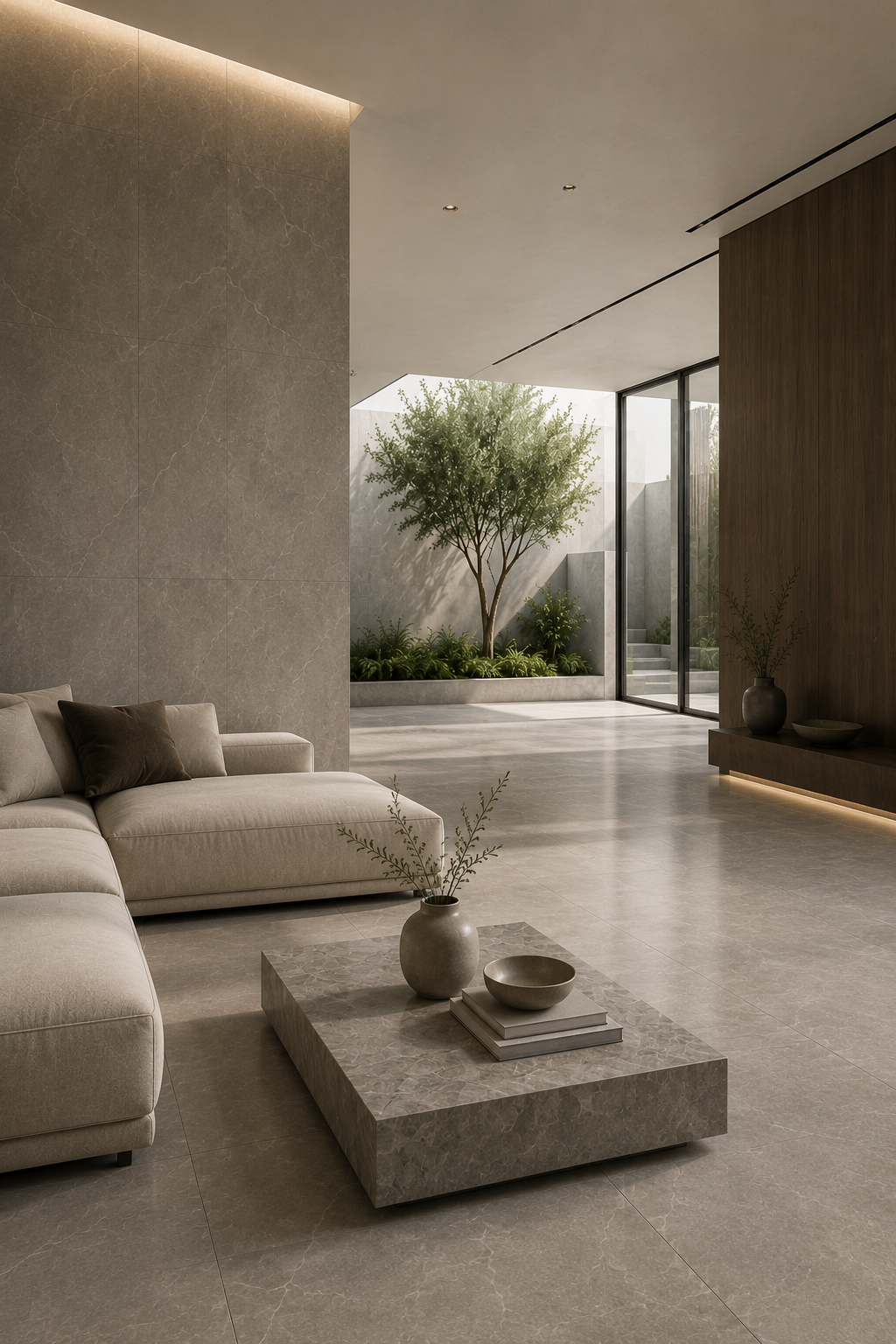
Porcelain pricing in Abu Dhabi spans a genuinely wide range, and country of origin alone does not determine where a product sits in it. Grade, brand positioning, collection, finish and commercial terms all move the price as much as, or more than, where a tile was manufactured — a point covered in full in Edition 02 of this Journal. The three illustrations below, using 600×1200mm porcelain as the reference format, are intended to show that range rather than to suggest any one country or brand occupies a fixed position within it.
Non-Grade-A porcelain from some Indian manufacturers can be found from around this level. This is a lower-market illustration for that specific product category — not a statement that all Indian porcelain is priced or graded this way; strong Grade A product is also manufactured in India, at a correspondingly different price point.
A realistic range for good-quality Spanish Grade A porcelain in this format, depending on manufacturer, brand, collection, design and finish. This band, not the AED 120 figure below, represents where most good Spanish Grade A product in this format is typically found.
Premium Spanish Grade A porcelain from certain established manufacturers and flagship collections can reach approximately this level. This is an upper-end illustration, not the typical price of Spanish porcelain generally.
What actually moves a price within — or beyond — this range includes: country of manufacture, the specific manufacturer and brand positioning, grade, collection, design complexity, finish, format and thickness, documented technical characteristics, order quantity, current stock availability, and commercial terms agreed with the supplier. None of these figures represent a fixed Petrona selling price for any specific product, and none should be treated as a quotation. Pricing on any given tile should be confirmed directly with a supplier for the exact product, quantity and project in question.
"Grade A," sometimes called "first quality," is a commercial quality-grading term used throughout the tile trade to describe tiles that pass a manufacturer's visual and dimensional inspection with minimal surface defects, chips, warping or shade inconsistency. Tiles that fall short of this standard are typically sorted into Grade B, Grade C, or sold as "commercial grade," at correspondingly lower prices.
It is important to be precise about what this term is and is not. Grade A is standard, widely understood commercial terminology — not a formal international technical standard. There is no single ISO or ANSI "Grade A" certification that a manufacturer can be independently audited against; grading practices are set and applied by each manufacturer's own quality-control process. This does not make the term meaningless — a genuine Grade A batch is a real, useful signal of consistent visual and dimensional quality, and it is one of the main factors behind the price differences described in the previous chapter. But it is a different thing from a product's formal technical specifications — water absorption group, breaking strength, slip resistance — which are documented separately on the technical data sheet and should be checked independently, not assumed from the grade alone.
Beyond price and appearance, a handful of documented technical characteristics separate a well-specified porcelain floor from one that causes problems later. None of the values below apply uniformly to every product — they are what to ask for on the specific tile's own technical data sheet.
Water absorption
Porcelain is classified by a water absorption of 0.5% or less under ISO 13006 and ANSI A137.1 / ASTM C373. This single figure is the technical definition of porcelain and should be confirmed, not assumed, for any product marketed as porcelain.
Dimensions, thickness & rectification
Confirm the exact size, thickness, and whether the tile is rectified — mechanically ground to precise edges after firing. Rectification is what makes narrow, near-invisible grout joints possible at large format; an unrectified tile of the same nominal size needs a visibly wider joint.
Breaking strength & modulus of rupture
These mechanical properties, tested under standards such as ISO 10545 or ASTM C648, indicate how a tile resists structural stress in use. They matter most for heavy-traffic commercial floors and large-format installations.
Chemical & stain resistance
Relevant for kitchens, commercial kitchens and areas exposed to cleaning agents or spills — a product's data sheet should state its tested chemical-resistance class.
Slip resistance
For any wet or outdoor area, ask which standard the product was tested to — typically DCOF under ANSI A326.3, or an R-rating under DIN 51130 for barefoot wet conditions — and confirm the rating suits the specific application. A finish's appearance, matte or otherwise, is not a substitute for a tested rating.
Rectification, applicable standards & documentation
Where a product references European standards, EN 14411 is the applicable framework (broadly aligned with, though administratively distinct from, ISO 13006); genuinely ISO-compliant products should state this on their own documentation rather than it being assumed by category. As with grade, none of these figures should be treated as universal across "porcelain" as a category — always request the technical data sheet for the specific product being considered.
The general mechanics of matching a tile to a room — slip ratings, abrasion class, porcelain-versus-ceramic trade-offs — are covered in full in Edition 06 of this Journal, and villa-specific, room-by-room guidance (living areas, bedrooms, kitchens, bathrooms and outdoor zones) is covered at length in Edition 08. In brief, across the space types most relevant to an Abu Dhabi buyer:
Living areas & villa common areas
Usually the largest, most visible floor plates — large format, a rectified edge and a matte or honed finish tend to suit these spaces best.
Kitchens
Staining resistance and ease of cleaning matter most; matte and satin finishes generally hide daily marks better than gloss.
Bathrooms
Slip performance is the deciding factor, and it must come from a tested rating for that specific product, not an assumption based on a matte finish.
Outdoor areas & pool surrounds
Require a product specifically rated for outdoor and wet-barefoot use, with UV and thermal stability and a tested slip rating for that condition — an indoor-rated tile should not be assumed suitable outdoors.
Commercial spaces
Abrasion resistance (PEI class) and durability under sustained foot traffic generally take priority over the considerations that dominate residential selection.
In every case, suitability depends on the specific product's documented technical characteristics and finish — not on the general fact that a material is porcelain.
Choosing a supplier is as consequential as choosing the tile itself. A good porcelain supplier in Abu Dhabi should be able to offer a genuine range of sizes, finishes and designs; physical, full-format samples rather than small swatches; technical documentation for each product on request; clear visibility of current stock and batch/shade coordination for large orders; realistic delivery timelines; project-level support for larger specifications; and a clear, written commercial quotation rather than a verbal price alone.
Petrona is an Abu Dhabi-based building-materials supplier specialising in porcelain tiles, marble and natural stone, and related surface materials, with a showroom in Mussafah M44 displaying more than 320 porcelain designs and shades across full-format samples. Architects, designers, contractors and homeowners can compare finishes side by side in natural light and request current pricing and technical data sheets for the specific products they are considering, before placing an order.
Where can I buy porcelain tiles in Abu Dhabi?
Several building-materials suppliers and showrooms across the emirate carry porcelain, including Petrona's Mussafah M44 showroom. Compare suppliers on physical samples, technical documentation, stock visibility and a written quotation — not price alone.
How much do porcelain tiles cost in Abu Dhabi?
Pricing varies widely by grade, manufacturer, collection and finish. As an illustration for 600×1200mm porcelain: non-Grade-A Indian product can start from around AED 20/m², good Spanish Grade A typically runs approximately AED 50–75/m², and premium Spanish Grade A collections can reach around AED 120/m². These are market illustrations, not fixed prices — request a current quotation for your selected product.
Is 600×1200mm better than 600×600mm porcelain?
Neither is universally better. 600×1200mm gives a more continuous look with fewer joints, suited to larger open rooms; 600×600mm is easier to handle and generally produces less cutting wastage in smaller or irregular spaces.
Is porcelain suitable for villas in Abu Dhabi?
Yes — porcelain is widely used across villa interiors, wet areas and outdoor zones, provided each specific product is matched to that zone's technical demands. See Edition 08 of this Journal for a full villa-specific guide.
What porcelain finish is suitable for bathrooms?
Matte and textured finishes are common choices, but slip performance must come from the product's tested rating (DCOF or an R-rating), not from the finish's appearance alone.
Can porcelain tiles be used outdoors in the UAE?
Yes, provided the specific product is rated for outdoor and wet-barefoot use, with a tested slip rating for that condition — an indoor-rated tile should not be assumed suitable outdoors.
What should I check before buying porcelain tiles?
Water absorption group, rectification status, shade-variation rating, calibre consistency, and — for wet or outdoor areas — a tested slip-resistance rating, all confirmed from the product's technical data sheet.
Is Spanish porcelain available in Abu Dhabi?
Yes, alongside porcelain from Italy, India, Turkey and other manufacturing countries. Origin alone does not determine quality or price — grade and the product's own documentation matter more.
What does Grade A porcelain mean?
A commercial quality-grading term for tiles that pass visual and dimensional inspection with minimal defects. It is standard trade terminology, not a formal international technical standard.
What is the difference between porcelain tiles and porcelain slabs?
The same material at different scales — tiles up to around 120×120cm for standard floor and wall use, and large-format slabs from roughly 120×240cm to 160×320cm for countertops, cladding and façades.
- ISO 13006 (Ceramic tiles — Definitions, classification, characteristics and marking) and ANSI A137.1 / ASTM C373 — 0.5% water absorption threshold defining porcelain, already verified and cited in Editions 01, 05, 06 and 08 of this Journal.
- EN 14411 (Ceramic tiles — Definitions, classification, characteristics, evaluation of conformity and marking) — the applicable European tile standard referenced for buyers comparing European-sourced product documentation.
- ANSI A326.3 (DCOF wet slip-resistance test method) and DIN 51130 (R-rating ramp test for barefoot wet areas) — slip-resistance standards, previously cited in Edition 08 of this Journal.
- ISO 10545 (Ceramic tiles — test methods) and ASTM C648 — breaking strength and modulus of rupture test methods referenced for mechanical performance.
- Petrona's own catalogued product range (tile formats 20×120cm–120×120cm; slabs 120×240cm–160×320cm; outdoor formats 60×60cm–100×100cm at 20mm) — Petrona 2.0 Knowledge Base, previously cited in Edition 08 of this Journal.
- Country-of-origin quality analysis — see Edition 02 of this Journal, "Italian, Spanish, Indian & UAE Porcelain: Does Country of Origin Really Matter?", for the full treatment this guide's pricing chapter builds on.
- Grade A / commercial quality-grading terminology — general tile-trade classification practice (manufacturer visual/dimensional inspection sorting first-quality output from Grade B/C or commercial-grade output); no single ISO or ANSI certification defines the term, distinct from the technical standards cited above.
- Illustrative AED/m² price ranges in Chapter IV reflect general Abu Dhabi/UAE market positioning for the described product categories as of August 2026, based on Petrona's own market experience; they are not fixed Petrona selling prices for any specific SKU and should not be relied on as a quotation.
- See also Editions 01, 02, 03, 06 and 08 of The Petrona Journal for the deeper technical and origin-specific treatment referenced throughout this guide.