
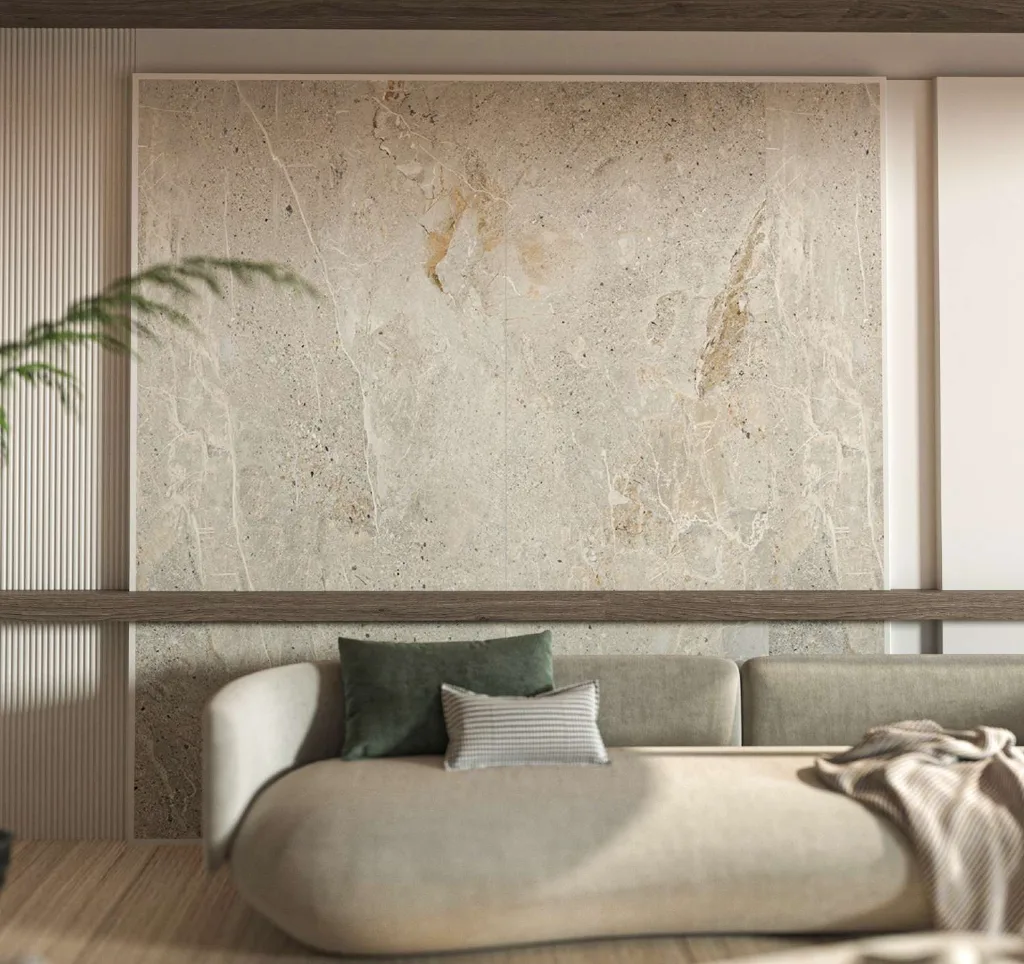
Spend an afternoon in any tile showroom in the Gulf and you will hear the same question, asked with the confidence of settled fact: "Is it Italian?" It comes from homeowners choosing a villa floor and from contractors pricing a tower. Behind it sits an assumption so widely held that it is almost never examined — that a tile's passport determines its quality, and that Italian porcelain is, by definition, the best of it.
It is a reasonable assumption. It is also an incomplete one.
The honest answer is more interesting than either the marketing or the cynicism. Country of origin genuinely tells you something — about design culture, about industrial heritage, about the traditions a factory grew up inside. What it cannot tell you is whether the specific tile in your hand will still look composed after fifteen years of a family, a hotel lobby, or a July terrace in Abu Dhabi.
That answer is written somewhere else entirely: on the datasheet. This edition sets out what the flag on the box really means, what it cannot mean, and what to look at instead.
Every reputation here was earned
Which is precisely why they are so durable — and so easily misread. Each of the great tile nations became great for a specific reason, and knowing the reason is the fastest way to see what it does and doesn't guarantee.
Italy — the design engine
Modern porcelain was largely shaped in one place: the Sassuolo district of Emilia-Romagna, where manufacturers, machinery makers and glaze chemists have spent seventy years refining one another. That density is the whole point. Italy's advantage was never a superior clay deposit — it was proximity. Designers next to engineers next to the people building the kilns.
The result shows up in a statistic that surprises almost everyone, and we will come back to it shortly.
Spain — the industrial artist
Spain's industry grew up around Castellón and developed along a different line: remarkable consistency at serious scale. Where Italy tends to lead on the avant-garde, Spain excels at taking a strong contemporary idea and producing it flawlessly, in volume, at a price that survives contact with a real budget. In 2024 Spain produced around 416 million square metres — more than Italy — and ranks second only to Italy in export value. For many architects, Spanish porcelain is the most efficient meeting point of design and delivery.
India — scale, and what it bought
India is now the world's second-largest producer, at roughly 2.4 billion square metres a year — around six times Italy's output. What matters more than the number is what a decade of investment purchased: Italian and Spanish presses, digital printers and kilns installed in Morbi, Gujarat, along with the technical people to run them.
The consequence is a genuinely wide spectrum. The best Indian plants run the same equipment as the best European ones and produce porcelain that meets the same standards. The weakest do not. India, more than anywhere, is where the manufacturer's name matters more than the country's.
China — the giant
China produced around 5.9 billion square metres in 2024 — close to 40 per cent of everything made on earth — and is simultaneously one of the world's top three tile exporters by value. Both facts are true at once, and together they explain the confusion.
A market that size contains everything: world-class plants supplying international brands, and plants that are not. Nothing about the words "made in China" tells you which one you are holding. The question was never the country — it is the factory, and the paperwork it can produce.
Turkey — the quiet technician
Turkey rarely enters the conversation and probably should. Its manufacturers produce around 318 million square metres and have built a reputation for solid technical porcelain — particularly in large formats — at competitive prices, with the logistical advantage of sitting close to both Europe and the Gulf.
The same table, read differently
Set the origins side by side and something becomes obvious. The left column changes. The right column does not.
Eighth by volume. First by value.
If country of origin were truly a proxy for quality, the world's most admired porcelain would come from the country that makes the most of it. It does not. Italy ranks eighth among tile-producing nations by volume, yet leads the world in export value — a gap that exists because its reputation was built on design, engineering and consistency. None of those things are geographic. They are decisions a company makes, which means they are decisions another company, somewhere else, can also make.
≈ 370 Million m² · 2024
Ahead of Spain and China
“A country builds a reputation. A factory builds a tile.”Petrona Journal · Edition No. 02
Closer to home than most people realise
Porcelain has been manufactured in the Emirates since 1989, when the first plants opened in Ras Al Khaimah — drawing on local clay and, unusually for the region at the time, on European process technology from the very beginning. Nearly four decades later the UAE sits among the world's notable tile exporters by value, in the group alongside India, Turkey, Poland and Brazil that together accounts for roughly a fifth of global tile exports.
What has accelerated things is national industrial policy. "Make it in the Emirates", launched in 2021 as part of the wider Operation 300bn strategy, aims to raise the industrial sector's contribution to GDP from AED 133 billion to AED 300 billion by 2031. For manufacturers this has meant practical things rather than slogans: support for advanced production technology, an In-Country Value programme that rewards local sourcing, and encouragement to secure raw materials — clay, feldspar — regionally rather than by import. By 2024, more than 1,300 products carried the "Made in the Emirates" mark.
A tile developed in the UAE is developed against the conditions it will actually live in — Gulf thermal cycling, fine dust, and sunlight that pushes surface temperatures far above the air temperature. That is a design brief no imported product answers by default.
The practical advantages rarely appear in a brochure. Lead times in days rather than shipping weeks. The ability to reorder a matching batch in year three, from a plant you can visit. On phased developments, that is often the difference between a specification that survives the programme and one that quietly gets substituted.
None of which makes UAE porcelain automatically superior — that would be exactly the error this article is arguing against, simply pointed in a friendlier direction. It makes it genuinely competitive, and worth judging on precisely the same evidence as everything else on the shelf.
Nine things that matter more than the flag
This is the heart of the matter. Everything below is measurable, and every one of them varies more between two factories in the same country than between two countries.
Country of origin is a useful shorthand for design culture and industrial heritage. It is not a specification. A tile from an excellent factory in India will outperform a tile from a weak factory in Italy every time — and the datasheet will tell you which is which long before you have to guess.
Where origin helps, and where it quietly stops mattering
None of this means origin is irrelevant. It means origin is one input among several, and its weight changes completely depending on what you are building.
For domestic traffic, almost any porcelain from a competent plant will outlive the décor around it. Choose on finish, format and the abrasion class suited to a home. Origin here is a matter of taste and budget, not performance.
Specify by classification, never by country. Request the ISO test reports, and confirm the plant can supply matching batches across phased handovers. This is where unverified assumptions become expensive.
Water absorption at or below 0.5% and an appropriate slip rating outrank every passport. Products developed for Gulf conditions hold a real, testable advantage here.
This is where origin genuinely earns its reputation. If a particular surface exists only in a Sassuolo or Castellón catalogue, that is a perfectly legitimate reason to buy it — you are buying the design, and it is worth the money.
Indian and UAE plants running current European equipment offer the widest gap between price and performance available today. Verify the plant, then buy without apology.
Lead times, batch availability and the ability to reorder in year three routinely outrank origin entirely. Regional manufacture is a structural advantage, not a compromise.
Three questions to ask any supplier
-
May I see the datasheet?
Ten seconds with a datasheet tells you more than ten minutes discussing countries. Absorption, breaking strength, abrasion class, slip rating. A supplier who cannot produce one does not fully know what they are selling.
-
Which factory made it?
Not which country — which manufacturer. That single name carries the technology, the quality control and the track record. It is the variable that actually determines what arrives on site.
-
Can I get the same batch again in two years?
Shade and calibre drift between production runs. For phased projects and future repairs, the answer to this can matter more than every other factor combined — and it is the question almost nobody asks.
Final thoughts
Country of origin is not meaningless. It is a real signal about design culture and industrial heritage, and there are moments — a specific surface, a specific catalogue — when it is exactly the right reason to choose. But it is a starting point, not a specification.
The floors that disappoint people are almost never the ones that failed a test. They are the ones nobody tested. Ask for the datasheet. Ask for the factory. Ask what happens in year three. The flag will still be on the box — it will simply have stopped doing work it was never capable of doing.
Every origin discussed here can be seen side by side at the Petrona showroom, and we would rather you asked all three questions. If you are still choosing between materials before you get to origin, our previous edition — Porcelain vs Ceramic — is the place to start.
- MECS / Acimac Research Centre — World Production and Consumption of Ceramic Tiles, 13th edition (2025), reporting 2024 data. Source of national production volumes cited throughout.
- Ceramic World Review / Ceramic World Web — country-level production, export and market analysis, 2024–2025.
- ISO 13006 — Ceramic tiles: Definitions, classification, characteristics and marking. Defines the ≤ 0.5% water-absorption threshold for porcelain (Group BIa).
- ISO 10545 series — Ceramic tiles: Test methods, including Part 3 (water absorption), Part 4 (breaking strength) and Parts 6–7 (abrasion resistance).
- ANSI A137.1 — American National Standard Specifications for Ceramic Tile. Tile Council of North America.
- UAE Ministry of Industry and Advanced Technology (MoIAT) — "Make it in the Emirates" and Operation 300bn industrial strategy; National In-Country Value programme.