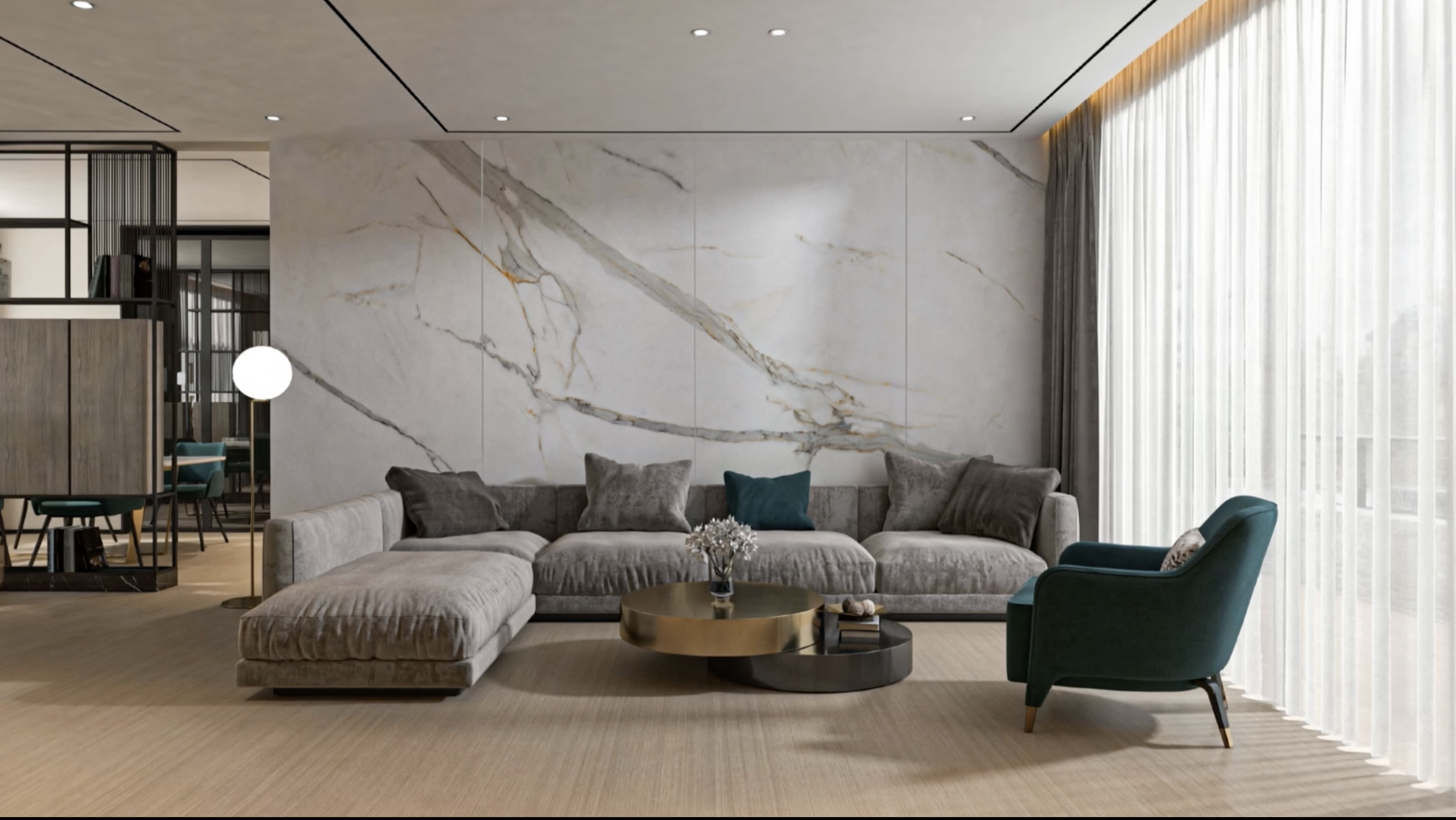
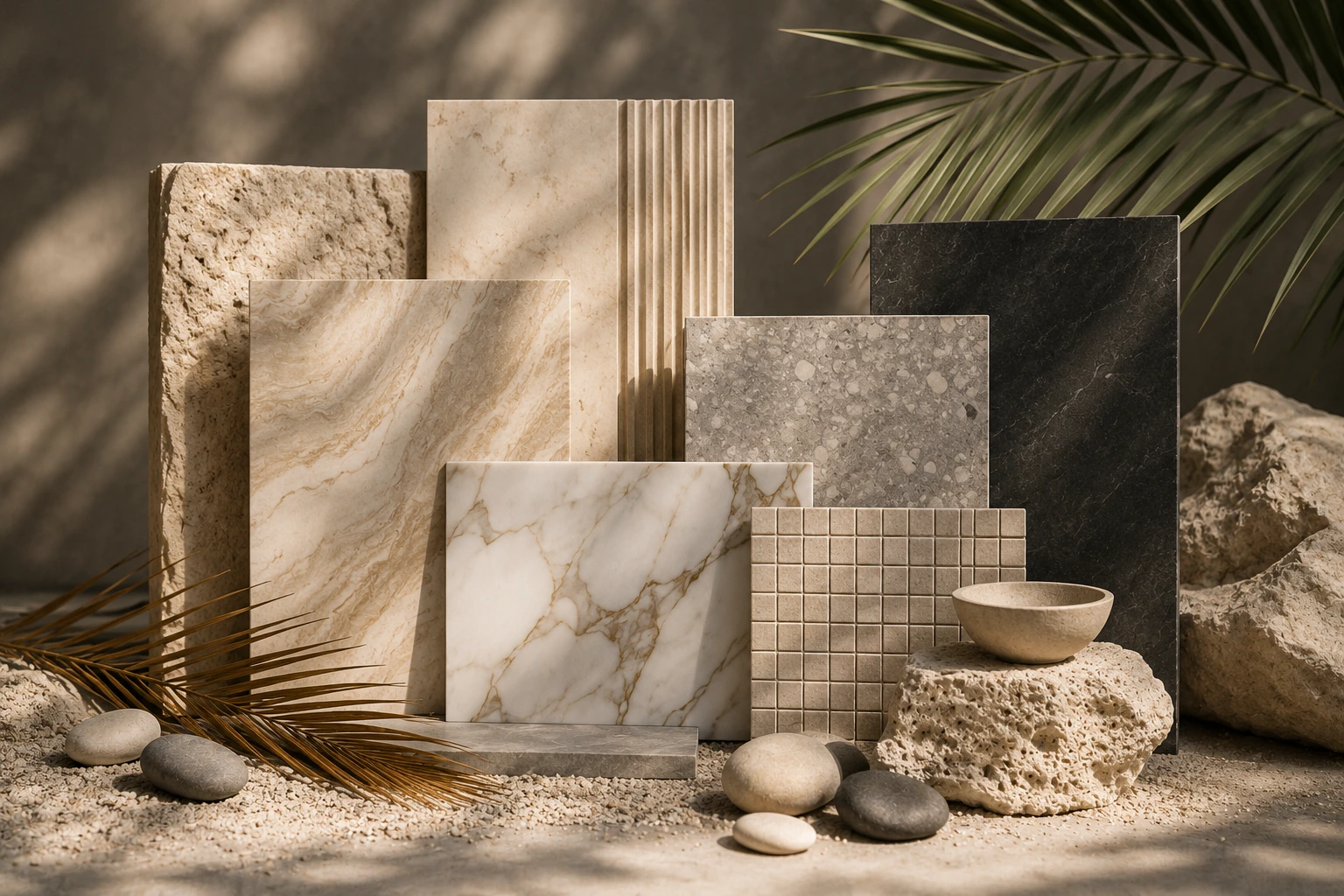
The best building materials for the UAE's hot desert climate are dense, low-porosity, UV-stable surfaces: porcelain tile and large-format sintered stone for floors, walls and façades; vitreous china or solid-surface materials for sanitary ware; and textured, slip-rated finishes for outdoor and wet areas. Porous natural stones such as untreated limestone and many marbles are less reliable in the UAE, because their open pore structure is vulnerable to salt weathering and staining under the region's combination of extreme heat, high coastal humidity, airborne salinity and seasonal dust. The right material still depends on application, exposure, and budget — this guide explains why, material by material.
What makes the UAE climate so demanding on materials?
The UAE has a hot desert climate (Köppen classification BWh), with summer highs regularly exceeding 45°C and mild winters around 24–26°C by day. That heat alone is manageable for most quality building materials. What makes material selection genuinely difficult is that heat rarely arrives alone — it combines with several other stress factors that interact with each other.
The six stress factors, defined
Coastal cities including Abu Dhabi and Dubai commonly see relative humidity of 75–90% during summer nights and early mornings — markedly higher than desert-interior locations, and high enough to keep surfaces damp for extended periods. Combined with proximity to the sea, this brings airborne salinity: fine salt particles that settle on and, in porous materials, migrate into a surface.
UV exposure is severe and prolonged: the UAE regularly reaches the "extreme" category (11 and above) on the World Health Organization's Global Solar UV Index scale for much of the year. Seasonal dust is also a genuine, recurring feature of the climate, driven by the Shamal wind — a northwesterly airflow with a well-documented peak season roughly from late May to mid-August. Finally, the wide swing between summer surface temperatures and cooler winter nights causes real thermal movement in large-format installations, which is why movement joints are a genuine engineering requirement, not a formality (see Chapter 7).
Most material failures attributed to "UAE heat" are actually caused by a combination of heat, humidity and salt acting on a porous material over years of cycling — not by heat on its own. That's why density and low water absorption, not heat resistance in isolation, are the properties that matter most.
Why does density matter more than heat resistance?
Porcelain tile is classified under ISO 13006 (Group BIa, dry-pressed tiles) and ANSI A137.1 as having water absorption of 0.5% or less, tested per ASTM C373 or ISO 10545-3. That single figure is the reason porcelain performs so well in the UAE: a surface that barely absorbs water cannot host the salt-crystallization cycles that damage porous stone, and it does not provide the moisture pathway that stains or discolours a surface over time.
Standard ceramic tile, by contrast, typically has higher water absorption — often well above the 0.5% porcelain threshold — which is why it is generally recommended for interior walls and lighter-use interior floors rather than exterior or wet-area applications in this climate. We covered this distinction, and the standards behind it, in detail in an earlier edition: Porcelain vs Ceramic: What's the Difference — and Which Should You Choose?
Colour stability is the other reason porcelain suits the UAE specifically. Its pigmentation is mineral-based and fired into a dense body, rather than an applied organic dye — organic pigments are markedly more susceptible to UV photodegradation (fading and "chalking") than fired mineral pigments, which matters given the region's consistently extreme UV exposure.
Where does natural stone work, and where doesn't it?
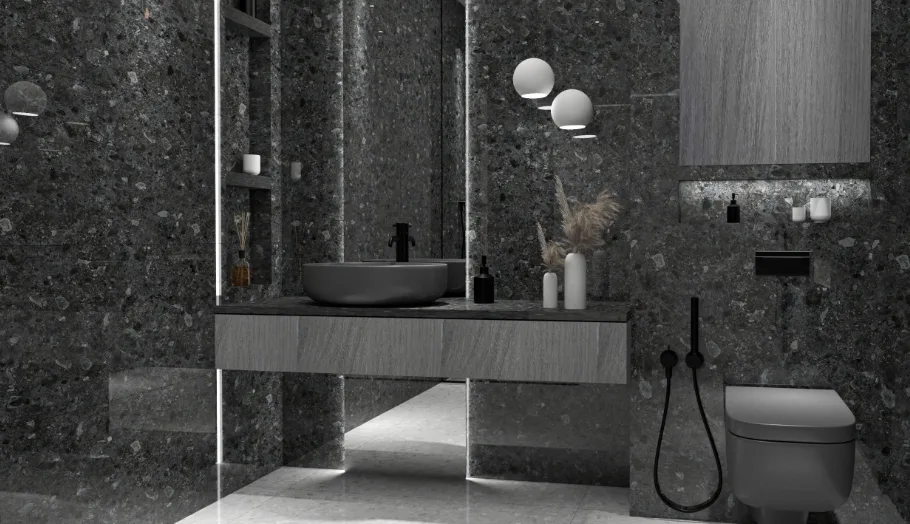
Natural stone is not one material — its climate performance varies enormously by type. Granite, a dense igneous stone, is genuinely well-suited to UAE conditions, including exterior use, because of its low porosity and hardness. Marble, travertine, and limestone are a different matter: all three are calcium-carbonate-based, comparatively porous stones that can absorb moisture and the salts carried within it.
Salt weathering: the mechanism, in plain terms
Salt weathering is a well-documented phenomenon in materials science and heritage conservation. Saline moisture is drawn into a porous stone's pores by capillary action; as the surface dries, the water evaporates but the dissolved salts remain and crystallize — both at the surface (visible as efflorescence) and within the pores themselves. Repeated wetting-and-drying cycles, exactly what a humid coastal climate provides, cause these crystals to grow and exert pressure on the pore walls from the inside, eventually leading to granular disintegration, flaking, or scaling. Sulfate salts are generally documented as more destructive than the chloride salts common in sea air, but both contribute over time.
Marble and limestone are not automatically unsuitable for the UAE — many interior applications, sheltered from direct weather and sealed appropriately, perform well for years. The distinction that matters is exposure: a marble feature wall in a climate-controlled interior faces a very different set of conditions from the same stone used as exterior cladding or pool surrounds.
Where a marble or travertine look is wanted in an exposed or wet exterior location, a marble-effect porcelain or sintered stone surface (Chapter 4) is generally the more durable substitute, since it reproduces the appearance without the underlying porosity.
What are sintered stone surfaces, and where do they fit?
Sintered (or "compact") stone surfaces are manufactured by compressing mineral raw materials under very high heat and pressure, without the resin binder used in engineered quartz. The result is a category of large-format slabs commonly described as having near-zero water absorption — typically cited at under 0.1% — along with high resistance to UV fading and heat, since there is no organic resin component to degrade.
That combination makes sintered stone a genuine option for both exterior cladding and countertops in the same installation, where matching an interior worktop to an exterior façade or kitchen island is desired. In practical terms for the UAE, sintered stone sits alongside porcelain as one of the two material categories best equipped to resist the region's full combination of heat, UV, humidity and salt — the choice between them is generally one of aesthetic and budget rather than climate performance.
Porcelain, natural stone and sintered stone, compared
The table below summarises how the three main hard-surface categories compare against the UAE's specific stress factors.
What sanitary ware materials suit UAE humidity?
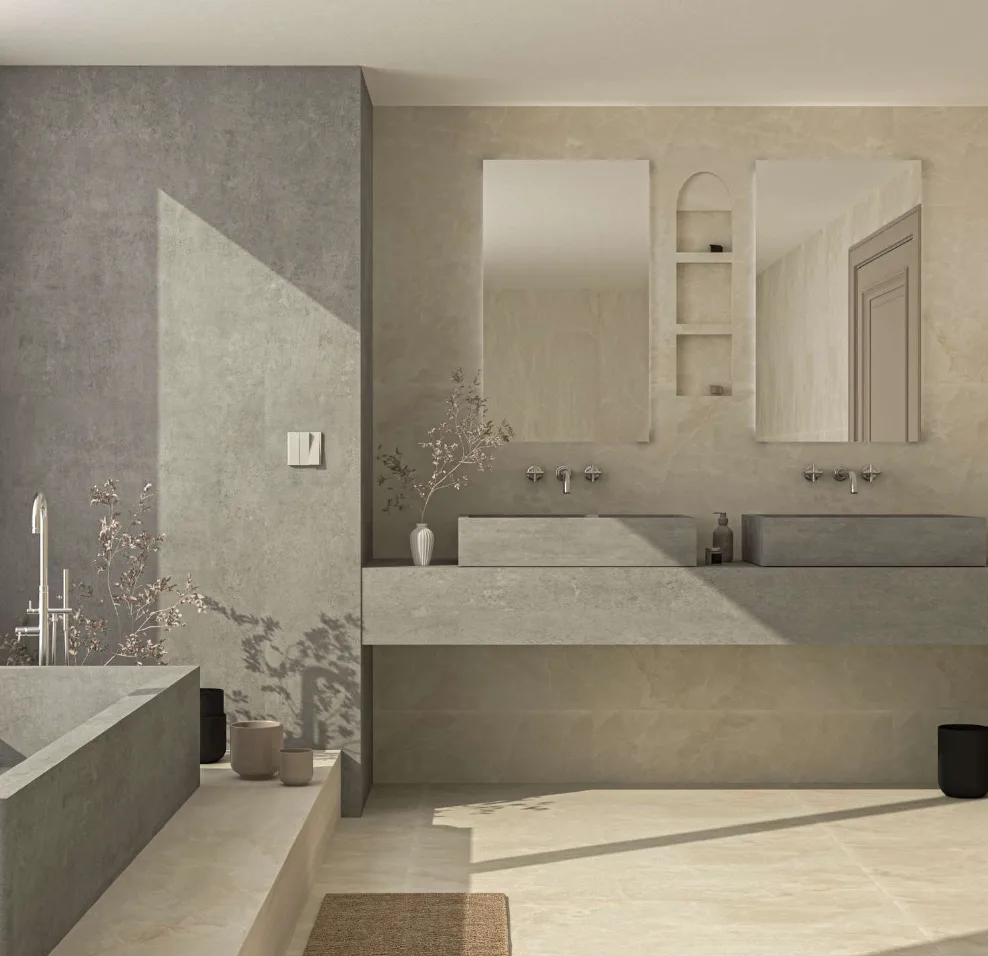
Vitreous china — fired ceramic sanitaryware — remains the standard for basins, WCs and similar fixtures, precisely because firing produces the same kind of dense, low-porosity body that makes porcelain tile perform well: it does not absorb moisture or corrode. Acrylic and solid-surface basins offer a similar humidity resistance with a different aesthetic and installation profile, and are common in contemporary vanity designs.
For fittings and hardware — taps, mixers, shower fixtures — the practical consideration in a humid, salt-air environment is corrosion resistance. Finishes and base metals genuinely rated for humid or coastal use will outlast standard-grade hardware in a bathroom that sees regular high humidity, particularly in coastal properties.
What works best for façades, terraces and pool decks?
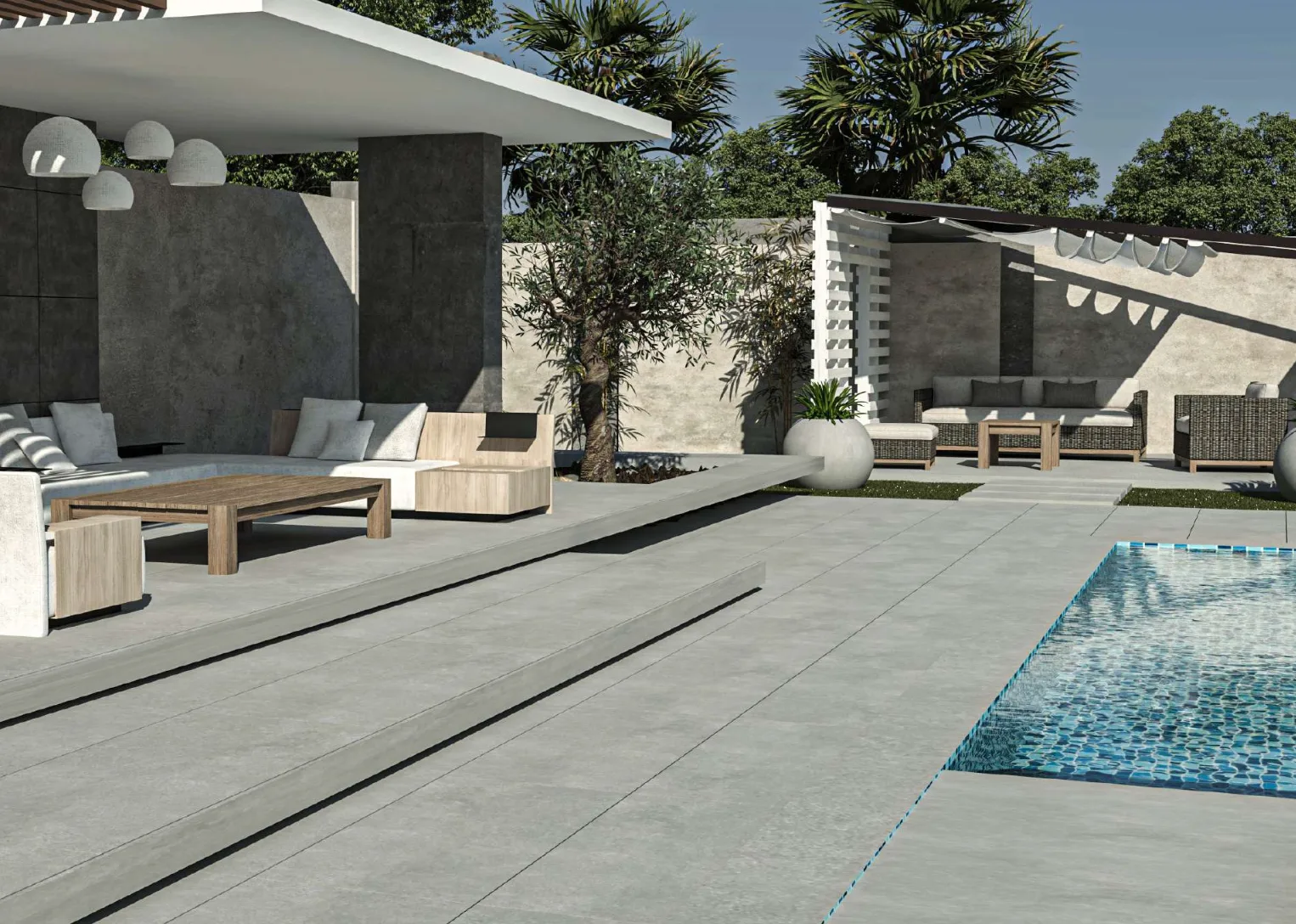
Large-format porcelain has become the dominant façade and terrace material in contemporary Gulf architecture, a shift we covered in depth in an earlier edition: The New Façade: Large-Format Porcelain in Contemporary Architecture. The 20mm (2cm) outdoor paver, installed on raised pedestals, is now the standard technical approach for terraces and pool decks — it drains quickly, resists the region's heat and salt exposure, and remains serviceable from beneath.
For pool decks and any surface routinely wet underfoot, slip resistance is a genuine safety specification, not a cosmetic finish choice. The widely referenced benchmark is a Dynamic Coefficient of Friction (DCOF) of at least 0.42 under ANSI A137.1 / A326.3 testing for level surfaces expected to be walked on when wet — a textured, structured or matte finish is required to meet this reliably; polished finishes generally do not.
Thermal movement joints: a genuine requirement
Large exterior tile, stone and porcelain installations expand and contract measurably across the UAE's wide temperature swing between summer daytime surface heat and cooler winter nights. Industry guidance — most widely referenced from the Tile Council of North America's movement-joint recommendations — calls for movement joints to be sized and spaced according to the expected thermal differential, using an appropriately elastic sealant. This is genuine structural detailing that should be specified by a qualified installer, architect, or structural consultant for each project; it is not a fixed number that applies identically to every installation (see Chapter 9).
Common questions from UAE projects
-
Does a coastal villa need different materials from an inland desert villa?
Often, yes. Coastal locations combine high humidity with airborne salinity, the specific combination that drives salt weathering in porous stone — inland desert interiors are typically drier, even though they can be equally hot. A coastal project has a stronger case for prioritising low-porosity materials throughout, including on protected elevations.
-
How should dust affect material and maintenance choices?
Seasonal dust, driven by the Shamal wind, is a recurring feature of the UAE climate rather than an occasional event. Dense, smooth-finished materials such as porcelain are easier to clean of settled dust than textured natural stone, though textured exterior finishes are still specified where slip resistance is the priority — the trade-off is a maintenance consideration, not a durability one.
-
Is natural stone ever appropriate outdoors in the UAE?
Yes, with the right stone: granite is dense enough to perform well in exterior UAE conditions. Marble, travertine and limestone are the categories that require caution outdoors specifically because of their higher porosity — sealing helps but does not eliminate the underlying vulnerability, and is a maintenance commitment, not a one-time fix.
-
What should I ask a supplier or consultant before specifying an exterior material?
Ask for the water absorption rating and the standard it was tested against (ISO 10545-3 or ASTM C373), the slip-resistance rating for wet-area use, and whether the manufacturer or installer has UAE-specific or Gulf-region movement-joint guidance for the project's exposure and format. A credible supplier or consultant will have straightforward answers to all three.
When does this become a job for a specialist?
Everything in this guide is general material-selection guidance, grounded in published standards and material science — it is not a substitute for project-specific engineering. Movement-joint spacing and width, structural loading for large-format cladding, waterproofing detailing, and façade fixing systems all depend on the specific building, exposure, and format involved, and should be specified by a qualified architect, structural engineer, or specialist installer for each project. Where this guide says a material "generally performs well," that is a starting point for a conversation with a consultant — not a specification.
Frequently asked questions
What is the best flooring material for UAE villas?
Large-format porcelain tile is the most reliable general-purpose choice, indoors and out, because its ≤0.5% water absorption (ISO 13006) resists staining, salt damage and UV colour change. Natural stone suits sheltered interiors; dense sintered stone performs comparably to porcelain at larger formats.
Can marble be used outdoors in the UAE?
Generally not recommended without protection — untreated marble is porous and vulnerable to salt weathering and etching. A marble-effect porcelain or sintered stone surface is the more durable substitute for exterior use.
What water absorption rating should UAE exterior tiles have?
0.5% or less, per ISO 13006 (Group BIa) or ANSI A137.1, tested to ASTM C373 or ISO 10545-3 — the same porcelain threshold used worldwide, which happens to also protect against the UAE's actual risk factors: salt crystallization and moisture-driven staining.
Do porcelain tiles fade in UAE sun?
Well-manufactured porcelain resists UV fading because its colour is fired mineral pigment within a dense body, not an applied organic dye — far more colour-stable under the UAE's extreme UV exposure than painted or dyed surfaces.
What slip resistance rating is needed for pool decks and wet areas?
A minimum DCOF of 0.42 under ANSI A137.1 / A326.3 testing is the widely referenced benchmark for level, walked-on-when-wet surfaces. Specify a textured or matte finish rated for wet-area use, not a polished one.
Are movement joints necessary for large tile or stone installations in the UAE?
Yes — the region's wide thermal swing between summer and winter causes real movement in large installations. Movement-joint sizing (per guidance such as the TCNA's) should be specified per project by a qualified installer or consultant.
Is natural stone worse than porcelain in humid coastal UAE locations?
For porous stones like limestone and many marbles, yes — coastal humidity plus airborne salt is exactly the condition that drives salt weathering. Denser stones like granite, and non-porous porcelain or sintered stone, are largely unaffected by this mechanism.
What sanitary ware material resists UAE humidity best?
Vitreous china and solid-surface or acrylic basins are the standard humidity-resistant choices, being non-porous or effectively sealed. For fittings, finishes rated for humid or coastal environments outperform standard-grade hardware.
Material selection in the UAE ultimately comes down to matching a surface's actual physical properties — water absorption, density, and finish — to the specific combination of heat, humidity, salinity, dust, and thermal movement a given application will face. Petrona's own range spans porcelain tiles, large-format slabs and outdoor porcelain selected against exactly these criteria, and our showroom team is glad to talk through the right choice for a specific project, coastal or inland. For how this climate brief plays out specifically across a villa's rooms and outdoor areas, see Best Porcelain Tiles for Villas in the UAE.
- ISO 13006 — Ceramic tiles: Definitions, classification, characteristics and marking. International Organization for Standardization. Group BIa defines porcelain (dry-pressed, water absorption ≤0.5%).
- ANSI A137.1 / A326.3 — American National Standard Specifications for Ceramic Tile and companion DCOF test standard. Tile Council of North America. Defines the porcelain water-absorption threshold and the 0.42 minimum DCOF benchmark for wet-walkable floors.
- ISO 10545 series — Ceramic tiles: Test methods, including Part 3 (water absorption), Part 4 (breaking strength) and Parts 6–7 (abrasion resistance).
- ASTM C373 — Standard Test Methods for Determination of Water Absorption and Associated Properties of Ceramic Tile. ASTM International.
- Tile Council of North America (TCNA) — Handbook for Ceramic, Glass, and Stone Tile Installation, Detail EJ171, Movement Joint Guidelines.
- World Health Organization / ICNIRP — Global Solar UV Index, "extreme" exposure category (11+).
- Peer-reviewed materials science and conservation literature on salt weathering of porous stone (crystallization/subflorescence mechanism), and general climatology of the UAE's Shamal wind and dust season.
- How UAE heat specifically affects adhesive open time and installation practice is covered in full in a later edition of this Journal on tile adhesives, grouts and installation systems.
General guidance only. Project-specific engineering, structural, and installation requirements should be confirmed with a qualified consultant.