A high-quality porcelain tile can still perform badly. That statement sounds like a contradiction until you consider what actually determines whether a floor stays flat, quiet and intact for twenty years: not the tile alone, but everything installed with it — the substrate it sits on, the adhesive bonding it down, the grout filling its joints, and the movement joints accommodating the small, constant expansion and contraction every building goes through. Edition 01 of this Journal set out what makes porcelain itself a strong material. This edition looks at everything around it — because a strong material installed on a weak system fails for reasons that have nothing to do with the tile's own quality.
It is tempting, when a floor develops a hollow-sounding tile or a cracked grout line, to treat it as an installer's mistake. Sometimes it is. But installation failures are just as often a specification failure — the wrong adhesive class for the application, a substrate that was never brought within tolerance, a movement joint that was designed on paper and omitted on site, or an adhesive that skinned over in the time it took to walk back to the mixing bucket on a hot afternoon. Getting the visible tile right and getting the invisible system right are two different disciplines, and both have to succeed for the installation to last.
Six components, one system.
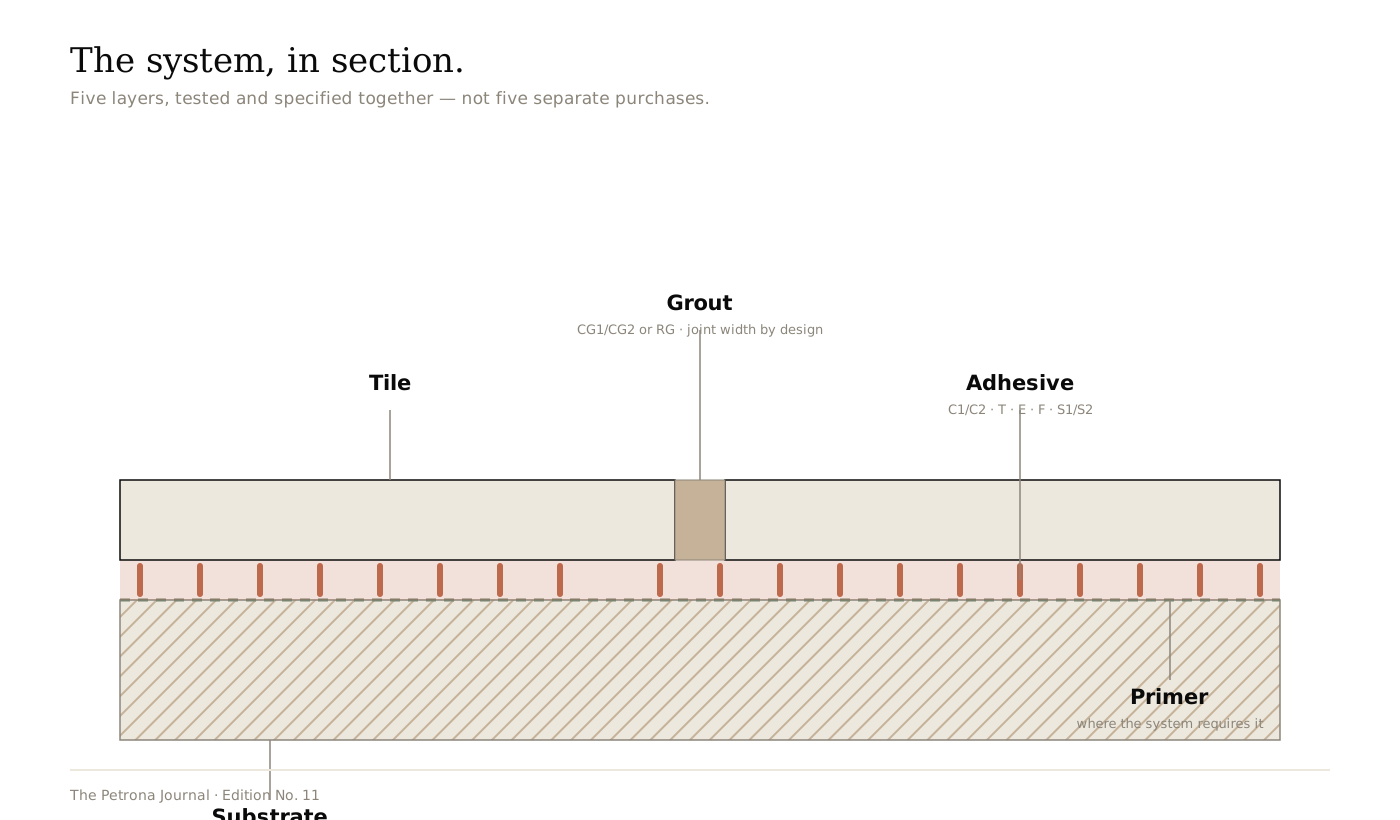
A complete tile installation is a stack of decisions, not a single product: the substrate itself; substrate preparation to bring it flat, sound and clean; a primer where the adhesive manufacturer's system requires one; the adhesive; the tile; the grout; the movement joints that separate the finished field into manageable sections; the skill of the installation itself; and the curing conditions the whole assembly is left to set in. Change any one of these without checking the rest, and the system the manufacturer tested and warranted no longer applies.
Nothing in this edition should be read as a universal installation instruction. Adhesive and grout selection, trowel size, coverage and movement-joint layout all depend on the specific tile, substrate, manufacturer's system and application — always confirm against the adhesive and tile manufacturer's own technical data before specifying or installing.
Tile adhesive is classified under EN 12004 (the European standard also reflected, with some differences, in ISO 13007), which sorts adhesives into three base families before any further classification is applied.
The three base families
Cementitious (C) — a cement-based powder mixed with water or a latex additive, the most widely used family for general tiling. Dispersion (D) — a ready-mixed, paste-form adhesive supplied pre-blended, generally used for smaller-format, absorbent tile in lighter-duty interior applications. Reaction resin (R) — a chemically curing adhesive (typically epoxy or similar resin systems), used where chemical resistance, very high bond strength or moisture-sensitive substrates make a cement-based product unsuitable.
C1 vs C2: what the numbers mean.
Within the cementitious family, EN 12004 sets two performance classes. C1 is a normal-performance adhesive, required to reach a minimum tensile adhesion strength of 0.5 N/mm². C2 is an improved-performance adhesive, required to reach at least 1.0 N/mm² — double the bond strength. Porcelain's very low water absorption means it does not "key" into an adhesive bed the way a more porous ceramic body does, so C2 is the more common specification for porcelain generally, and effectively the standard for large-format porcelain, exterior work and wet areas.
A further set of letters refines the classification. T (reduced slip) means a tile fixed to a vertical surface will not slide down more than 0.5mm before the adhesive sets — essential for wall tiling. E (extended open time) means the adhesive still achieves proper adhesion even when the tile is pressed in later than the standard window — valuable in hot or fast-drying conditions, addressed in full in Chapter V. F (fast setting) means the adhesive reaches usable strength within around six hours, allowing earlier grouting or foot traffic. Deformability is graded separately under EN 12002: S1 (deformable) and S2 (highly deformable) describe how much the cured adhesive can flex under load or substrate movement without losing its bond — a property that matters more, not less, as tile format increases. A fully specified adhesive might therefore be labelled, for example, C2TES1 — improved cementitious, reduced slip, extended open time, deformable.
Grout is easy to treat as a finishing touch — the colour that fills the gaps between tiles. It is that, but it is also a functional part of the installation system, governed by its own European standard, EN 13888, with two base families and its own performance classes.
Cementitious grout (CG) is graded CG1 (normal class) or CG2 (improved class) — CG2 offers better resistance to abrasion and water absorption and is the more common specification for busier or more exposed surfaces, including heated floors, exteriors and areas subject to temperature and humidity swings. Two further suffixes can apply to either class: W for reduced water absorption, and A for high abrasion resistance — a fully specified product might appear as CG2 WA. Reaction-resin grout (RG), chemically cured rather than cement-based, offers markedly higher chemical and stain resistance and very low water absorption, at the cost of a more technique-sensitive, less forgiving application and generally higher cost.
Neither family is automatically the better choice. A cementitious CG2 grout is entirely adequate — and considerably easier to work with — for the great majority of residential floors and walls. Reaction-resin grout earns its higher cost in swimming pools, commercial kitchens and other environments with sustained chemical or moisture exposure, where its resistance genuinely matters. Presenting epoxy grout as universally superior ignores the trade-off in workability and cost that comes with it.
Grout joint width is itself a specification decision, not an aesthetic afterthought — narrower joints read as a more continuous surface but leave less tolerance for tile-size variation, while wider joints accommodate calibration differences more forgivingly. And grout's role is not purely visual: it closes the surface against dirt and moisture ingress, contributes to a hygienic, cleanable joint in wet areas and kitchens, and — within limits set by the movement joints elsewhere in the system, not by the grout itself — helps the finished field read as one coherent surface rather than a collection of individual tiles.
Large-format porcelain — broadly, formats from around 600×600mm upward, and especially 600×1200mm, 1200×1200mm and larger slabs — has become one of the defining surfaces of contemporary Gulf architecture, a shift Edition 03 of this Journal covered from the design side. The installation side deserves equal attention, because a larger tile is markedly less forgiving of every shortcut a smaller one might tolerate.
Substrate flatness
A small tile can bridge minor substrate irregularity without visible consequence. A 1200mm slab cannot — the same deviation that was invisible under a 300mm tile becomes lippage, rocking, or a stress point under a large-format one. Substrate flatness tolerance becomes a specification requirement at scale, not a nice-to-have.
Coverage and back-buttering
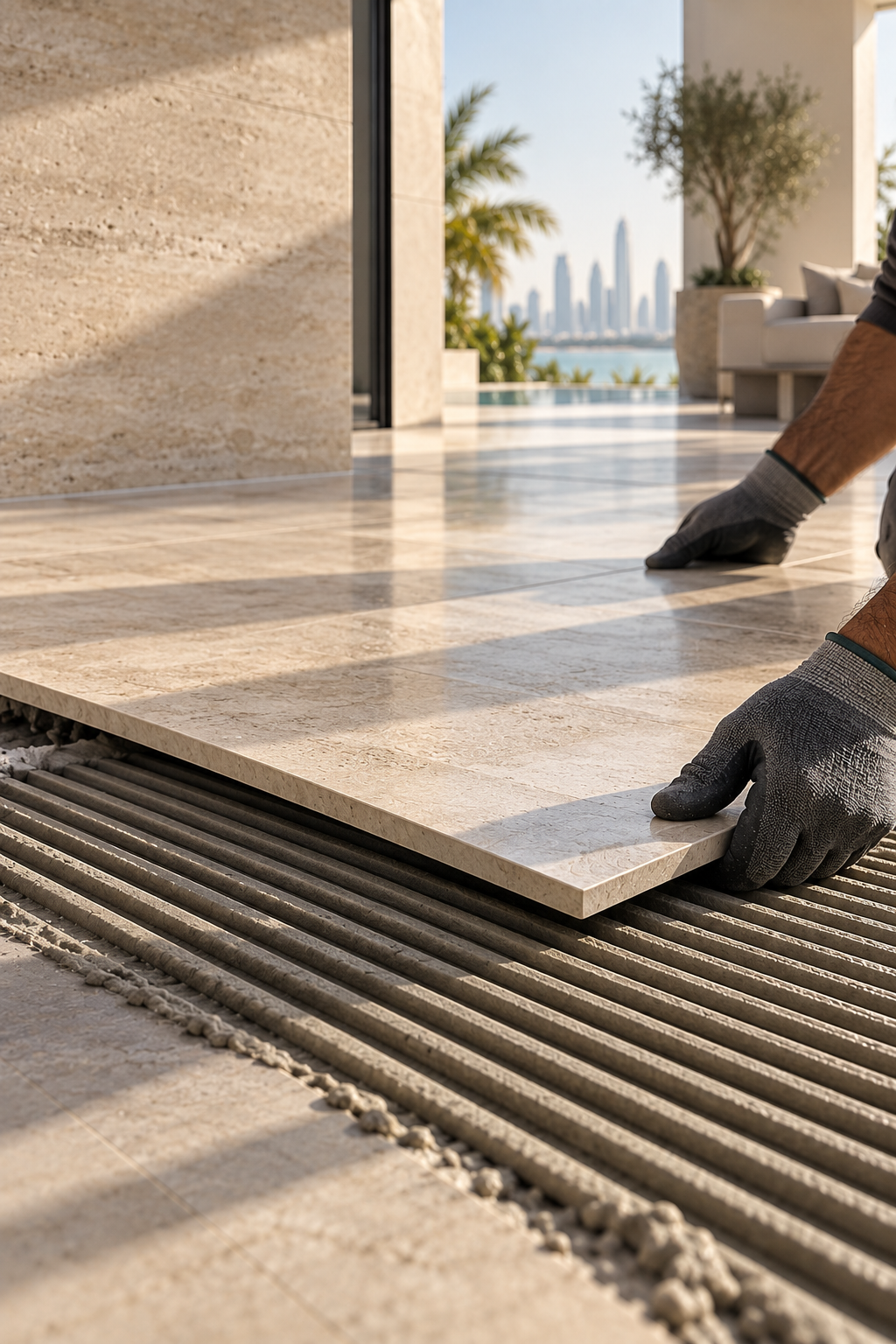
Industry guidance under ANSI A108.5 and the TCNA Handbook typically calls for adhesive coverage of around 80% for standard interior dry residential work, rising to a minimum of roughly 95% for wet areas, exterior installations, natural stone and — critically — all large-format tile, regardless of whether the setting is wet or dry. Achieving that higher figure on a large tile generally requires back-buttering: combing adhesive onto both the substrate and the back of the tile with a suitably sized notched trowel, rather than combing the substrate alone. The trowel notch size itself needs to be matched to the tile format under the adhesive manufacturer's own instructions — too fine a notch simply cannot deliver enough material to reach full coverage on a large slab.
Levelling systems, handling and movement joints
Tile-levelling clip-and-wedge systems are widely used on large-format work to hold adjoining tiles at a consistent height while the adhesive cures, controlling lippage across the joint. Large slabs also demand correct lifting and handling equipment — porcelain slabs are rigid but can crack under uneven support during transport and placement — and adequate curing time before grouting or foot traffic, rather than the accelerated schedule a smaller tile might tolerate. Movement joints, both at the perimeter of the installation and at intervals across the field, remain necessary at every format, but the consequence of omitting or under-specifying them scales with tile size: a large-format field with no relief for thermal or structural movement concentrates that stress at fewer, larger joints, which is exactly where cracking tends to appear first.
Exact trowel notch size, back-buttering technique, levelling-system spacing and movement-joint layout are all system-specific — set by the tile manufacturer, the adhesive manufacturer, and the project's structural detailing, not by a single number that applies everywhere. Confirm all four directly for the specific product and project before work begins.
Every cementitious adhesive has an "open time" — the window after troweling during which a tile can still be pressed in and achieve proper adhesion. Beyond that window, the exposed surface of the adhesive dries and forms a skin, and a tile pressed into skinned adhesive never bonds properly, no matter how carefully it is laid. Open time is a function of temperature, humidity and airflow, and the UAE's climate compresses it more than most installers coming from temperate markets expect.
Several adhesive manufacturers publish specific hot-weather guidance that applies once ambient or substrate temperature climbs into the high-20s°C and beyond — a threshold reached on most UAE afternoons for a large part of the year, and considerably exceeded on a sun-exposed exterior substrate, which can run well above ambient air temperature. Heat, direct sun and wind all accelerate the evaporation that skins an adhesive over; in combination, they can cut a normal open time to a fraction of its rated figure. This is a straightforward consequence of cement chemistry — hydration and evaporation both speed up as temperature rises — not a defect in the material.
What this means in practice
On UAE exterior work — terraces, pool decks, façades, balconies and villa outdoor areas — this generally translates into a handful of practical adjustments: working in smaller sections so adhesive is never troweled faster than it can be tiled; keeping bagged material and mixing water stored out of direct sun rather than in a hot site container; and, in many cases, specifying an adhesive carrying the extended open time (E) classification described in Chapter II, which is tested specifically to remain workable for longer than a standard product. None of these are exotic measures — they are standard hot-weather practice, applied because the UAE's ambient conditions make it necessary more often, and for more of the year, than in a temperate climate.
The same thermal exposure that shortens open time during installation continues to act on the finished surface afterward. Exterior porcelain, especially on façades, pool surrounds and open terraces such as those covered in Edition 08 of this Journal, experiences real daily and seasonal thermal movement, which is precisely what the movement joints discussed in Chapter IV exist to absorb — a detail that matters more, not less, once the installation is outdoors in a Gulf climate. Edition 05 of this Journal covers how the wider material palette holds up to UAE conditions beyond installation itself.
Most tile installation failures have more than one possible cause, and a confident single diagnosis without inspecting the actual site is rarely honest. What follows is a guide to the likely causes behind common symptoms — a starting point for asking the right questions, not a substitute for inspection.
Stand in a finished room and the tile is the only material anyone actually looks at. Nobody admires a notch-trowel pattern or a movement joint — by design, a good installation makes its own substructure invisible. But that invisibility is exactly why the hidden layer deserves more scrutiny, not less: a defect in the surface is obvious the day it's installed, while a defect in the adhesive, the substrate prep or the movement-joint layout can sit silently for months before it shows up as a cracked tile or a hollow sound underfoot.
Surface, adhesive, grout, substrate and installation are not five separate purchases that happen to end up in the same floor — they are one system, tested and warranted as a system by manufacturers precisely because substituting one component without checking the others breaks the assumptions the whole system relies on. A premium porcelain tile paired with an undersized adhesive, or installed over an out-of-tolerance substrate, does not perform like a premium installation. It performs like whichever component in the chain was weakest.
What this means for specification.
In practice, this argues for treating adhesive and grout selection as part of the same conversation as tile selection, not an afterthought resolved by whichever installer is on site that week. It also argues for scepticism toward any installation quote that doesn't specify which adhesive classification and grout type it assumes — because that choice, more than almost any other single decision on a project, determines whether the finished floor is still flat and sound in ten years, or in three.
A short set of questions, asked before installation begins rather than after a problem appears, resolves most of the risk this edition has covered.
Is the substrate within flatness tolerance for this tile format?
Larger formats need tighter tolerance — confirm this before adhesive selection, not after tiling has started.
Which adhesive classification does the manufacturer specify?
For this tile, this format, and this application — interior or exterior, wet or dry — not a generic "strong adhesive."
Has open time been checked against site conditions?
Ambient and substrate temperature on the day of installation, not the adhesive's rated figure in isolation.
What movement-joint layout has been specified?
And does it follow the adhesive and tile manufacturer's system guidance together with the project's own structural detailing?
Which grout classification suits this exposure?
A domestic bathroom, a swimming pool and a commercial kitchen do not share the same answer.
Has this installer worked with this specific system before, at this format?
Familiarity with the specific adhesive, trowel technique and levelling system in use measurably reduces installation risk.
Petrona supplies porcelain tiles and slabs — not adhesives or grout — and that is precisely why this edition exists. A supplier that only talks about the surface is leaving out half of what determines whether a client's floor performs the way the tile's own quality promises. The honest position is the one this edition has taken throughout: the correct adhesive, grout and installation approach depend on the tile, the substrate, the application and the manufacturer's own system, and no single product or number is right for every project.
What Petrona can offer, alongside the material itself, is exactly that context — helping a client, contractor or consultant understand which classification and system considerations apply to the porcelain being specified, so that the conversation with an adhesive manufacturer, a grout supplier or an installer starts from an informed position rather than a guess.
For architects, contractors, consultants and homeowners specifying porcelain anywhere in the UAE, that is the conversation worth having before installation begins, not after a hollow-sounding tile forces it.
What adhesive should be used for porcelain tiles?
It depends on format, substrate and application, but most porcelain is installed with a C2-classified cementitious adhesive under EN 12004 — improved bond strength over a basic C1 product — with added deformability (S1/S2) and, in hot or fast-drying conditions, extended open time (E).
What is the difference between C1 and C2 tile adhesive?
C1 is normal-performance, minimum 0.5 N/mm² tensile adhesion. C2 is improved-performance, minimum 1.0 N/mm² — double the bond strength, and the more common specification for porcelain, large-format and wet/exterior work.
What adhesive is suitable for 60x120 porcelain tiles?
A 600×1200mm tile is large-format and is generally installed with a C2, S1/S2 adhesive, back-buttered with a large-notch trowel — the exact product and trowel size should follow the manufacturers' published system instructions for that format.
Is epoxy grout better than cement grout?
Not universally. Reaction-resin grout resists stains and chemicals better and suits pools, commercial kitchens and heavy wet-area exposure; cementitious CG2 grout is easier to apply and entirely adequate for most residential floors and walls.
What grout should be used in bathrooms?
An improved cementitious grout (CG2), ideally with reduced water absorption (W) for shower zones, generally performs well; reaction-resin grout is a stronger but more technique-sensitive option for heavier water exposure.
Why do porcelain tiles sound hollow?
Usually a void beneath the tile from incomplete adhesive coverage or an uneven substrate the adhesive didn't fully fill — not always full debonding, but always reduced bonded contact.
Why do tiles come loose after installation?
Common causes include the adhesive skinning over before the tile was placed, an adhesive not rated for the application, insufficient coverage, or unaccommodated substrate movement — often more than one factor together.
Does large-format porcelain need special adhesive?
Generally yes — a C2, S1/S2 adhesive applied by back-buttering, because larger tiles are far less forgiving of coverage gaps and substrate irregularity than smaller formats.
What tile adhesive should be used outdoors in the UAE?
Typically a C2 adhesive with S1/S2 deformability for thermal movement, often with extended open time (E), since UAE heat significantly shortens working time on exterior substrates.
How does UAE heat affect tile installation?
Heat, sun and wind accelerate evaporation, which can skin cementitious adhesive over well before its rated open time — reducing effective working time and requiring smaller work sections, shaded material storage, and often an extended-open-time product.
- EN 12004 — European standard for adhesives for ceramic tiles, defining the C (cementitious), D (dispersion) and R (reaction resin) base types and the C1/C2 performance classes and T/E/F supplementary classifications referenced in Chapter II.
- EN 12002 — European standard defining the S1 (deformable) and S2 (highly deformable) classification for cementitious adhesives and grouts used with EN 12004.
- EN 13888 — European standard for grout for tiles, defining the CG (cementitious grout) and RG (reaction resin grout) base types, the CG1/CG2 classes, and the W (reduced water absorption) and A (high abrasion resistance) supplementary classifications referenced in Chapter III.
- ANSI A118 series (including A118.1, A118.4, A118.15) and ANSI A108.19/A137.3 (gauged porcelain tile and panels) — United States standards covering broadly comparable, though not numerically identical, adhesive performance classes and large-format/gauged porcelain installation requirements.
- ANSI A108.5 and the Tile Council of North America (TCNA) Handbook for Ceramic, Glass, and Stone Tile Installation — industry guidance on minimum adhesive coverage percentages and movement-joint provision (TCNA EJ171) referenced in Chapters IV and V. Exact coverage and joint-spacing figures should always be confirmed against the current published standard and the manufacturer's own system instructions rather than assumed from general guidance.
- Mapei — Italian manufacturer of adhesives, sealants and chemical products for construction, founded in 1937 and headquartered in Milan, Italy. Referenced here as an example manufacturer publishing technical guidance on hot-weather tile installation, not as an endorsement or supply relationship claim.
- Kerakoll — Italian manufacturer of building materials including tile adhesives and grouts, headquartered in Sassuolo, Italy. Referenced here as an example manufacturer of large-format-porcelain adhesive systems, not as an endorsement or supply relationship claim.
- See Edition 01 of this Journal for the porcelain fundamentals this guide builds on, Edition 03 for large-format porcelain in architectural context, Edition 05 for material suitability across the wider UAE climate, and Edition 08 for room-by-room and outdoor villa specification.