
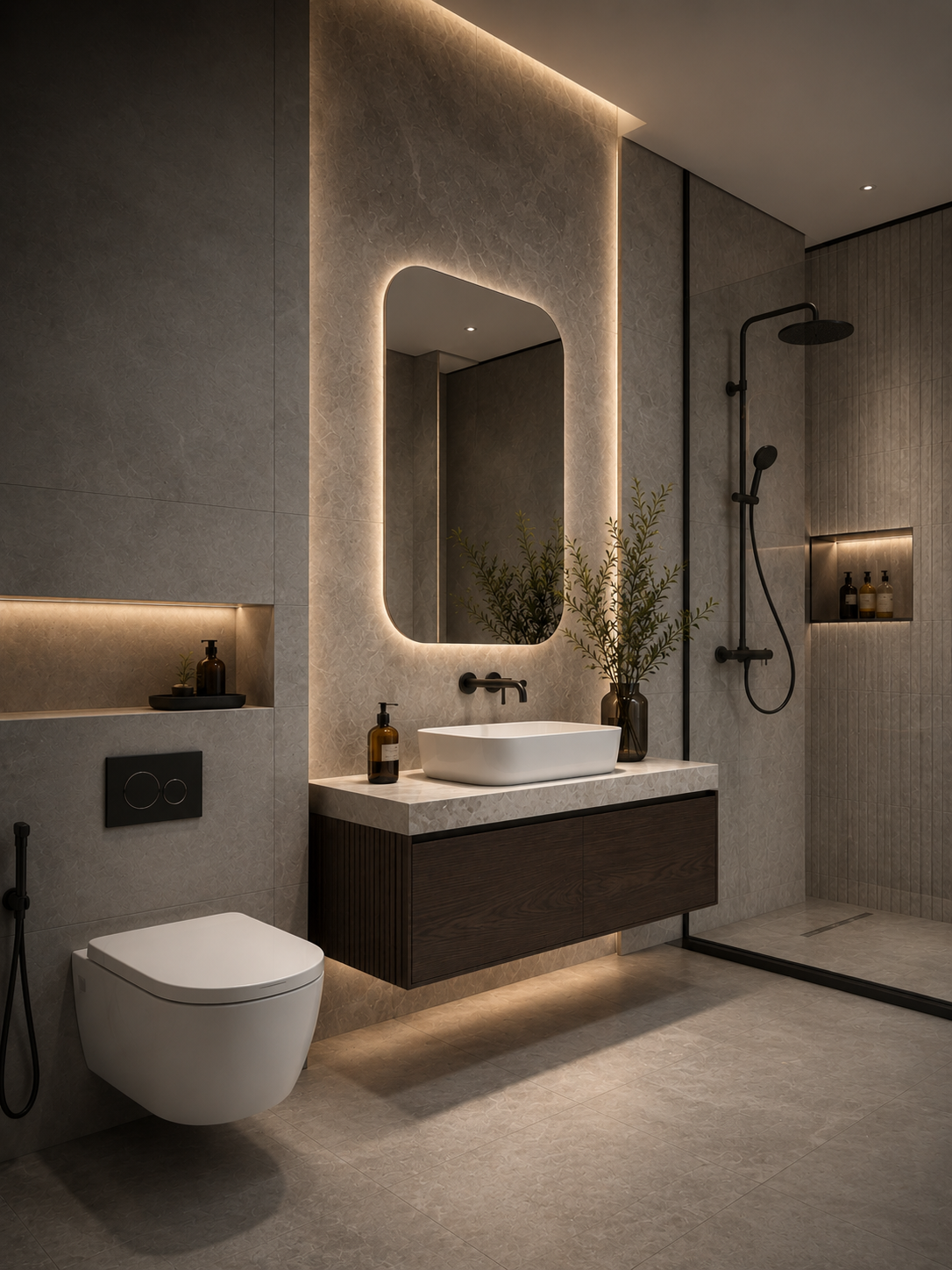
The bathroom has quietly become one of the most deliberately designed rooms in a contemporary UAE home. Where it was once treated as a purely functional space — fitted out at the end of a project once the porcelain, joinery and lighting decisions had already been made — it now tends to be planned as an integrated system, in which surfaces, sanitary ceramics, fittings, lighting and concealed technology are considered together from the start. That shift is visible across new villas in Abu Dhabi's outer communities, apartment renovations in the city, and hospitality interiors alike: the bathrooms that read as calm, coherent spaces are almost always the ones where the WC, basin and shower were specified alongside the tiling, not after it.
Sanitary ware — WCs, basins, bidets, mixers and shower fittings — is easy to treat as a last-minute selection, chosen from a catalogue once the walls are already tiled. But proportion, circulation and visual balance in a bathroom are set as much by where the WC sits relative to the door, how much clear floor space is left in front of the vanity, and how a shower glass panel interrupts the sightline, as they are by the tile itself. Getting this right is a planning question, not a shopping question, and it needs to happen before plumbing rough-in is fixed.
Why sanitary ware belongs in the specification phase.
Several practical considerations only resolve cleanly if sanitary ware is chosen early. Plumbing rough-in — the position of water supply and waste lines inside the wall or floor — has to match the specific WC, basin and mixer being installed, including whether the WC is wall-hung or floor-standing, and whether basin mixers are wall-mounted or deck-mounted. Concealed systems, covered in Chapter III, need their installation frame built into the wall before any tiling begins, which makes late substitution genuinely difficult. And maintenance access — inspection panels for concealed cisterns, isolation valves for future servicing — has to be designed in, not retrofitted.
Coordination with porcelain matters just as much. A basin or WC chosen in isolation can clash with the floor and wall tile in tone, scale or finish, even when each looks well made on its own. Chapter VII returns to this in more depth, but the underlying principle is set here: sanitary ware and surface materials are one specification, considered together, not two separate purchases that happen to end up in the same room.
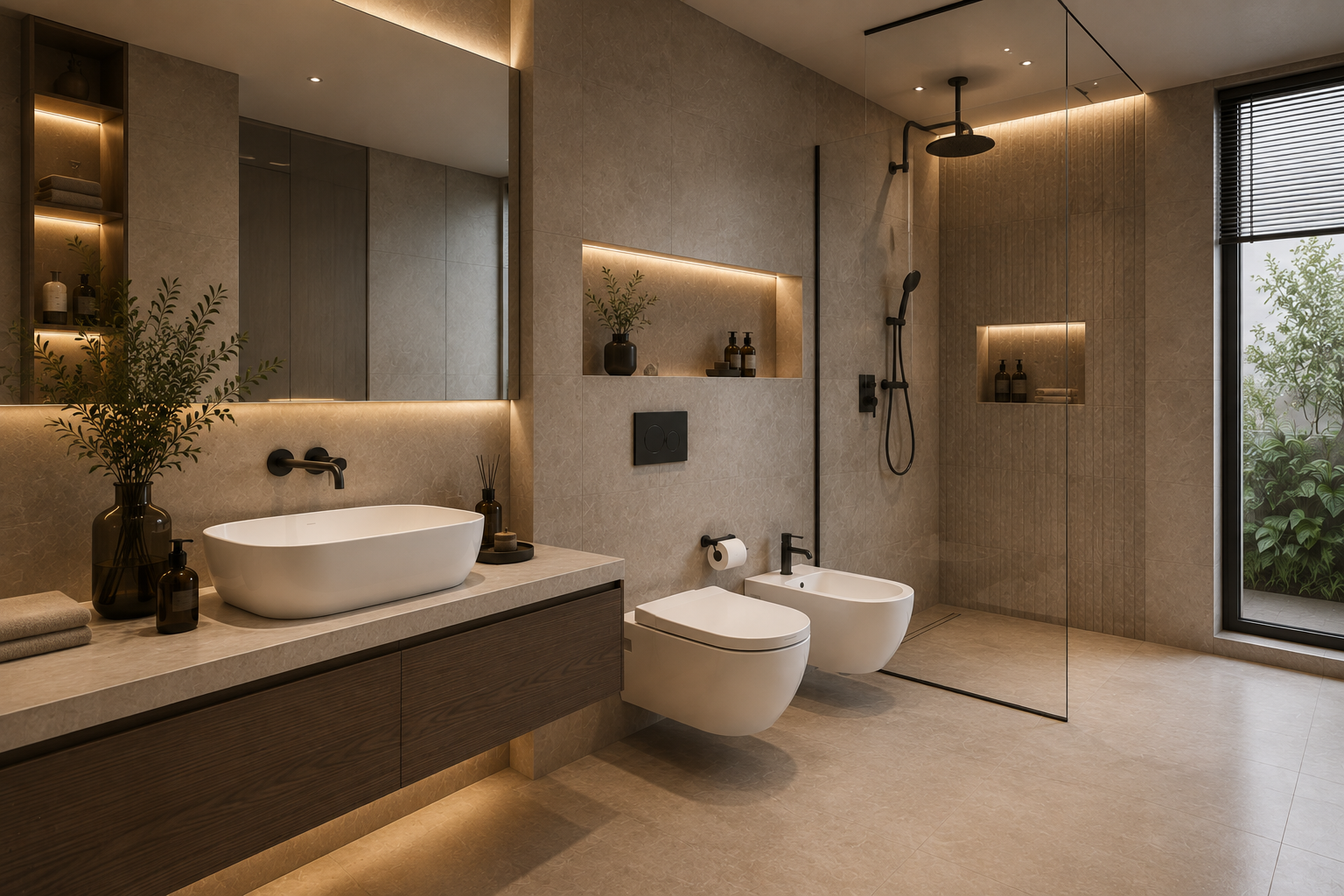
One of the earliest decisions in any bathroom specification is whether the WC sits on the floor or hangs from the wall, with its cistern concealed behind it. Both approaches are established and both remain appropriate depending on the project — the choice is not simply old versus new.
Floor-standing WCs
A floor-standing WC sits directly on the floor, usually with a close-coupled cistern visible behind the bowl. It is generally the simpler and less expensive installation, does not require a concealed frame built into the wall, and is straightforward to service, since the cistern and its internal components remain fully accessible. It suits renovations where opening up the wall is impractical, and secondary bathrooms where a concealed system's added cost and installation complexity are not necessary.
Wall-hung WCs
A wall-hung WC is fixed to a concealed installation frame set into or in front of the wall, with only the bowl visible and the cistern hidden behind the finished surface. It leaves more visible floor area, which reads as more spacious in a small bathroom and is genuinely easier to clean underneath and around. This is a large part of why wall-hung systems have become prominent in contemporary bathroom design across the UAE — but the trade-off is that the concealed frame and cistern must be correctly installed before tiling, and any future servicing of the hidden mechanism depends on an access panel being planned in from the start, rather than open access to the unit itself.
Wall-hung systems are not automatically the right choice for every project. A bathroom being finished in a hurry, on a wall that cannot easily accommodate a concealed frame, or in a building where future maintenance access is a genuine concern, may be better served by a well-specified floor-standing WC. The decision should follow from the project's actual constraints, not from which option looks more contemporary in a showroom.
The flush plate on a finished bathroom wall is a small, deliberately quiet detail — a rectangle of chrome or matte metal, usually the only visible sign that a concealed cistern sits behind it. Everything that actually does the work — the water tank, the flushing mechanism, the inlet and overflow valves — is hidden inside an installation frame set into or in front of the wall before any tiling begins. Understanding what is back there, and why it matters, is one of the more useful things a homeowner, designer or contractor can know before committing to a wall-hung system.
Geberit is one established manufacturer associated with this category of concealed cistern and installation-frame systems, widely used behind wall-hung WCs in contemporary bathrooms. The general principle that makes concealed installation systems worth taking seriously is straightforward: once tiling, plasterboard or stone cladding is fixed over the frame, the mechanism inside becomes far less accessible than a visible cistern would be. A fault that would take minutes to diagnose and fix on a floor-standing WC can mean opening a wall on a poorly planned concealed installation.
What a well-planned concealed installation includes
An installation frame structurally suited to the wall type and correctly secured; a cistern and flush plate that are confirmed compatible with each other and with the WC bowl being installed; a leak test carried out before the wall is closed, not assumed after; and — critically — a properly positioned access panel or serviceable flush plate mechanism, so that routine maintenance does not require breaking into finished tiling. None of this is visible in the finished room, which is exactly why it needs to be checked during installation rather than left to be discovered later.
Which installation frame and cistern is being used, whether the contractor has installed that specific system before, and how the flush plate mechanism is serviced without removing tiling. These are reasonable questions for any homeowner or designer to ask a contractor before a concealed system goes behind the wall.
The basin is usually the first thing a bathroom is judged by, and it comes in more configurations than most buyers initially consider.
Countertop and vessel basins
Sit above the vanity surface rather than being recessed into it — a countertop basin sits partially embedded, a vessel basin sits fully above it, as a distinct bowl. Both make a visual statement and are relatively easy to install, but sit at a different working height than a fully recessed basin, which is worth checking against the mirror and mixer height before finalising.
Integrated (under-counter) basins
Mounted beneath the countertop, with the counter's own material forming the visible rim. This gives a cleaner, more continuous surface and is generally easier to keep clean around the basin edge, at the cost of a more involved installation than a countertop basin.
Wall-hung basins
Fixed directly to the wall with no vanity cabinet beneath, in the same spirit as a wall-hung WC — more visible floor area, easier cleaning underneath, and a lighter visual footprint, at the cost of losing under-basin storage unless a separate cabinet or shelf is planned elsewhere.
Basin proportion and the rest of the vanity wall.
A basin does not work in isolation — its proportions have to sit correctly against the vanity's width and depth, the mixer's reach and height, the mirror's position, the lighting above it, and the storage built beneath or beside it. A vessel basin that looks striking on its own can crowd a narrow vanity or push the mixer too far from the basin's centre; a basin chosen before the vanity dimensions are finalised is a common, avoidable source of a bathroom that never quite feels resolved.
RAK Ceramics, a ceramics and sanitaryware manufacturer headquartered in Ras Al Khaimah, is one example of a manufacturer producing coordinated sanitary ceramic collections — WCs, basins and bathroom collections designed as a matching set rather than assembled from unrelated ranges. Coordinated collections of this kind can simplify specification precisely because the proportions, finish and detailing are designed to sit together from the outset.
Fittings — basin mixers, wall-mounted mixers, concealed shower mixers, overhead and hand showers — are where a bathroom's visual scheme meets its mechanical reality most directly. They are handled daily, they carry water under pressure, and they are, functionally, small mechanical products first and design objects second.
Basin and wall-mounted mixers
Deck-mounted basin mixers sit on the countertop beside the basin; wall-mounted mixers project from the wall above it, giving a cleaner counter but requiring the supply lines to be positioned correctly in the wall before tiling. Either works well when planned early; a wall-mounted mixer chosen after the wall is already tiled is a considerably harder retrofit.
Concealed shower mixers and controls
A concealed mixer sets the valve body into the wall, leaving only the control and outlet visible — the shower equivalent of a concealed cistern, and subject to the same principle: it has to be correctly installed and, ideally, tested before the wall is closed, since a fault afterward means reopening finished tiling.
Rain showers and hand showers
An overhead rain shower delivers a wide, gentle spray from above and has become a standard feature in contemporary walk-in showers across UAE villas and apartments; a hand shower on a slide rail adds practical flexibility for rinsing, cleaning the enclosure, or use by children. The two are typically run from the same concealed mixer or a dedicated diverter, and increasingly from thermostatic controls that hold a set temperature rather than requiring constant manual adjustment.
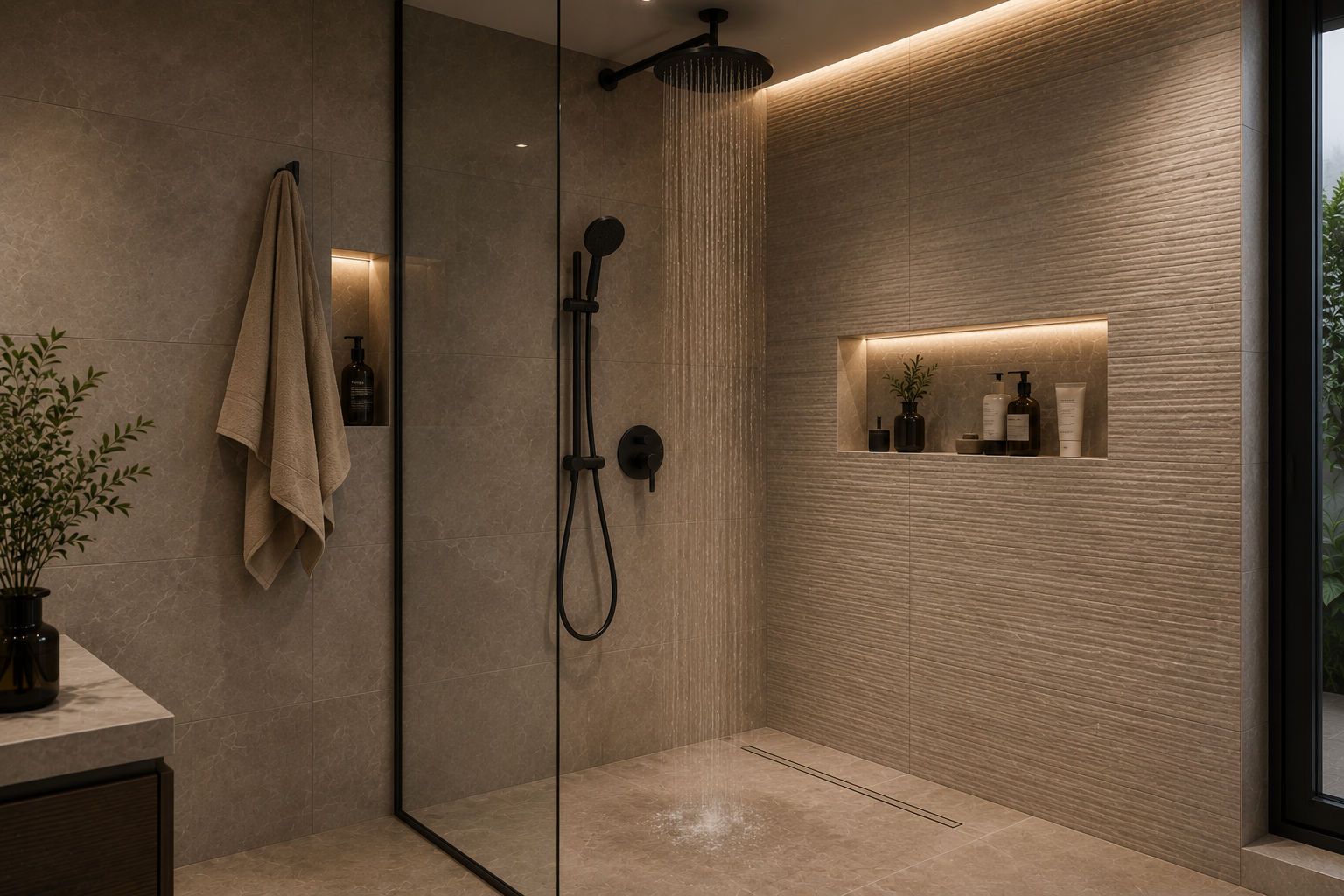
Fittings are mechanical products, not just finishes.
GROHE is one established manufacturer in this part of the bathroom — mixers, taps and shower systems, including thermostatic controls designed to hold a stable temperature. The broader point it illustrates is not specific to any one brand: a mixer's internal cartridge, valve quality and thermostatic mechanism determine how it performs and how long it lasts far more than its visible finish does. A well-finished mixer with a poor internal cartridge will feel stiff, drip, or fail within a few years regardless of how it looks on day one. Selecting fittings on functionality, serviceability and finish-coordination — not appearance alone — is the more durable approach, particularly for fittings used multiple times a day.
Sanitary ware and fittings vary considerably in quality behind a similar surface appearance. A handful of practical checks separate a well-specified bathroom from one that causes problems within a few years.
Ceramic quality
A well-fired, well-glazed ceramic resists staining, scratching and yellowing over time. Glaze quality is difficult to judge from a photograph — a physical sample, and a manufacturer with an established track record, are more reliable indicators than appearance alone.
Flushing performance
A WC's flushing system should clear the bowl reliably and quietly. This is a functional characteristic worth asking about directly, rather than assuming from the bowl's shape or brand positioning.
Internal fitting components
For mixers, the internal cartridge — commonly a ceramic disc cartridge in better-quality fittings — governs how smoothly the mixer operates and how long it lasts before it drips or seizes. Cheaper cartridges wear faster and are a common cause of fittings that feel stiff or fail early.
Installation system compatibility
For concealed cisterns and mixers, confirm the specific components — frame, cistern, flush plate, valve body — are designed to work together, rather than mixing parts from different systems and assuming compatibility.
Spare-parts availability and service support
Perhaps the most overlooked factor: whether the manufacturer has established distribution and service support in the UAE, so that a worn cartridge, a replacement flush plate or a spare valve can actually be sourced when needed, rather than requiring the entire fitting to be replaced.
Warranties
Warranty terms vary by manufacturer and product line and should be confirmed directly with the supplier for the specific product being purchased, rather than assumed from general brand reputation.
A bathroom's sanitary ware does not exist apart from its surfaces — the two are read together, and a bathroom feels resolved when they are specified as one composition rather than two separate decisions. Edition 01 of this Journal covers the fundamentals of porcelain as a material; this chapter looks specifically at how it should be considered alongside sanitary ware.
Tone and scale
Warm, stone-look and travertine-look porcelain in beige and warm grey tones — a dominant direction in current UAE interiors — generally sits well against off-white or warm-white ceramic sanitary ware and matte black or brushed-brass fittings, rather than stark white ceramics and polished chrome, which can read as visually colder against a warm floor. A cooler, concrete-look or pale grey porcelain suits crisper white ceramics and polished chrome more naturally. Neither pairing is fixed — the point is that tone should be considered together, not assumed to always work.
Grout and texture
Matching grout colour closely to the porcelain, rather than contrasting it, keeps large-format floors and walls reading as one continuous surface — letting the sanitary ware and fittings, rather than a grid of grout lines, define the room. This matters most in shower zones and around vanities, where grout lines are viewed at close range.
Matt surfaces and shower zones
Matte porcelain finishes are increasingly common on both floors and walls in contemporary bathrooms, and pair naturally with matte-finish fittings for a consistent surface language throughout the room. Where slip resistance matters — particularly shower floors and wet-area flooring — the tile's tested rating should be confirmed directly rather than assumed from a matte appearance; Edition 06 of this Journal covers slip-rating mechanics for wet areas in full.
Feature walls behind a freestanding basin or bath, or a single accent wall inside a shower zone, are common ways to introduce a stronger stone-look or veined porcelain design without extending it across the entire room — a technique that lets the sanitary ware read as the focal point in the rest of the space, with the feature wall as a backdrop rather than a competing element.
Bathroom specification in the UAE carries a few practical considerations specific to the local market — villas with multiple bathrooms built to the same standard, hospitality projects refreshed on defined cycles, and a construction market where contractor familiarity with a given installation system genuinely affects how well it is installed.
Waterproofing and ventilation come first
No amount of sanitary ware or surface quality compensates for poorly executed waterproofing behind wet-area tiling, or inadequate ventilation in an enclosed bathroom. These are foundational, unglamorous details that have to be correct before finishes go on — and they are considerably harder to fix once tiling and sanitary ware are installed over them.
Consistency across multiple bathrooms
A villa with four or five bathrooms benefits from specifying sanitary ware and fittings consistently across them — not necessarily identical, but drawn from a coordinated range — which simplifies both the original installation for the contractor and any future maintenance, since spare parts and servicing knowledge apply across every bathroom rather than being specific to one.
Contractor familiarity
A concealed installation system installed by a contractor experienced with that specific system generally performs more reliably than the same system installed by a crew encountering it for the first time. This is a reasonable, practical question to ask before committing to a concealed system: has this contractor installed this frame and cistern combination before.
Local product and service support
Choosing manufacturers with an established UAE distribution and service presence — rather than a product sourced without local support — reduces the risk of a straightforward repair turning into a lengthy wait for a part or a technician.
Edition 05 of this Journal previously covered sanitary ware and bathroom materials as part of a broader look at building materials suited to the UAE climate; this edition returns to the subject in full depth.
The bathrooms that work best are rarely the ones where the most expensive individual pieces were chosen. They are the ones where surfaces, sanitary ware and bathroom systems were considered together, as one specification, from the start — where the porcelain, the WC, the basin, the shower fittings and the concealed installation behind the wall were all decided with an understanding of how they would function and look as a single room, not assembled from a series of unrelated choices made at different stages of a project.
That is the perspective Petrona brings to a bathroom specification: attention to what is visible — tone, scale, finish, the way porcelain and ceramic sit together — and equal attention to what sits behind the finished surface, because a bathroom that looks resolved on day one but is difficult to service in year three has not, in the end, been well specified.
For homeowners, designers, contractors, consultants and developers working on a bathroom in Abu Dhabi or elsewhere in the UAE, that means treating porcelain and sanitary ware as a single conversation rather than two separate purchases — and it is a conversation Petrona is glad to have, at any stage of a project.
What sanitary ware should I choose for a UAE bathroom?
It depends on the project. Prioritise a manufacturer with established UAE service and spare-parts support, specify the WC, basin and fittings together rather than separately, and confirm concealed-installation requirements before finishes are set.
What is the difference between wall-hung and floor-standing toilets?
A wall-hung WC conceals its cistern inside a wall-mounted frame, freeing floor space and easing cleaning, but requires that frame installed correctly before tiling. A floor-standing WC has a visible, easily serviced cistern and a simpler installation, at the cost of more visible floor space.
What is a concealed cistern?
The water tank and flushing mechanism for a WC, installed inside a frame behind the wall, with only a flush plate visible on the finished surface. Geberit is one established manufacturer in this category. Correct installation and a planned access point matter more than usual, since the mechanism is hidden once finishes are complete.
What should I look for when buying sanitary ware?
Ceramic and glaze quality, flushing performance, internal fitting components such as mixer cartridges, installation-system compatibility, and — practically — whether spare parts and service support are available locally in the UAE.
Which sanitary ware brands are available in the UAE?
A wide range, including international and regional manufacturers such as GROHE (mixers and shower systems), Geberit (concealed cisterns and installation systems) and RAK Ceramics, a UAE-headquartered manufacturer of sanitary ceramics and coordinated bathroom collections.
How should sanitary ware be coordinated with porcelain tiles?
By considering tone, scale and finish together — warm stone-look porcelain generally suits warm-white ceramics and matte black or brushed fittings, while cooler porcelain suits crisper white ceramics and polished chrome — and by matching grout colour to the porcelain rather than contrasting it.
What should be considered when designing a bathroom in Abu Dhabi?
Correct waterproofing and ventilation before finishes are installed, consistent sanitary ware specification across multiple bathrooms, contractors experienced with the specific installation systems used, and manufacturers with genuine local spare-parts and service support.
What is a concealed shower mixer?
A shower mixer with its valve body set into the wall, leaving only the controls and outlet visible — the shower equivalent of a concealed cistern, and subject to the same installation and access considerations.
- GROHE — German manufacturer of bathroom and kitchen fittings, mixers and shower systems, founded 1936, headquartered in Düsseldorf, Germany. Referenced here as an example manufacturer for mixers, taps and shower systems, not as an endorsement or supply relationship claim.
- Geberit — Swiss manufacturer of sanitary technology, headquartered in Rapperswil-Jona, Switzerland, known for concealed cistern and prewall installation systems. Referenced here as an example manufacturer for concealed installation systems, not as an endorsement or supply relationship claim.
- RAK Ceramics — ceramics and sanitaryware manufacturer headquartered in Ras Al Khaimah, United Arab Emirates, producing tiles, sanitaryware and coordinated bathroom collections. Referenced here as an example manufacturer for sanitary ceramics, not as an endorsement or supply relationship claim.
- See Edition 01 of this Journal for the porcelain-versus-ceramic fundamentals this guide builds on, Edition 06 for slip-rating mechanics in wet areas, and Edition 05 for this Journal's earlier treatment of sanitary ware and bathroom materials within a wider climate-suitability guide.
- No manufacturer certifications, warranty terms or performance specifications are cited in this edition beyond the general company and product-category facts noted above; readers should confirm specific technical claims directly with the manufacturer or supplier of any product under consideration.