
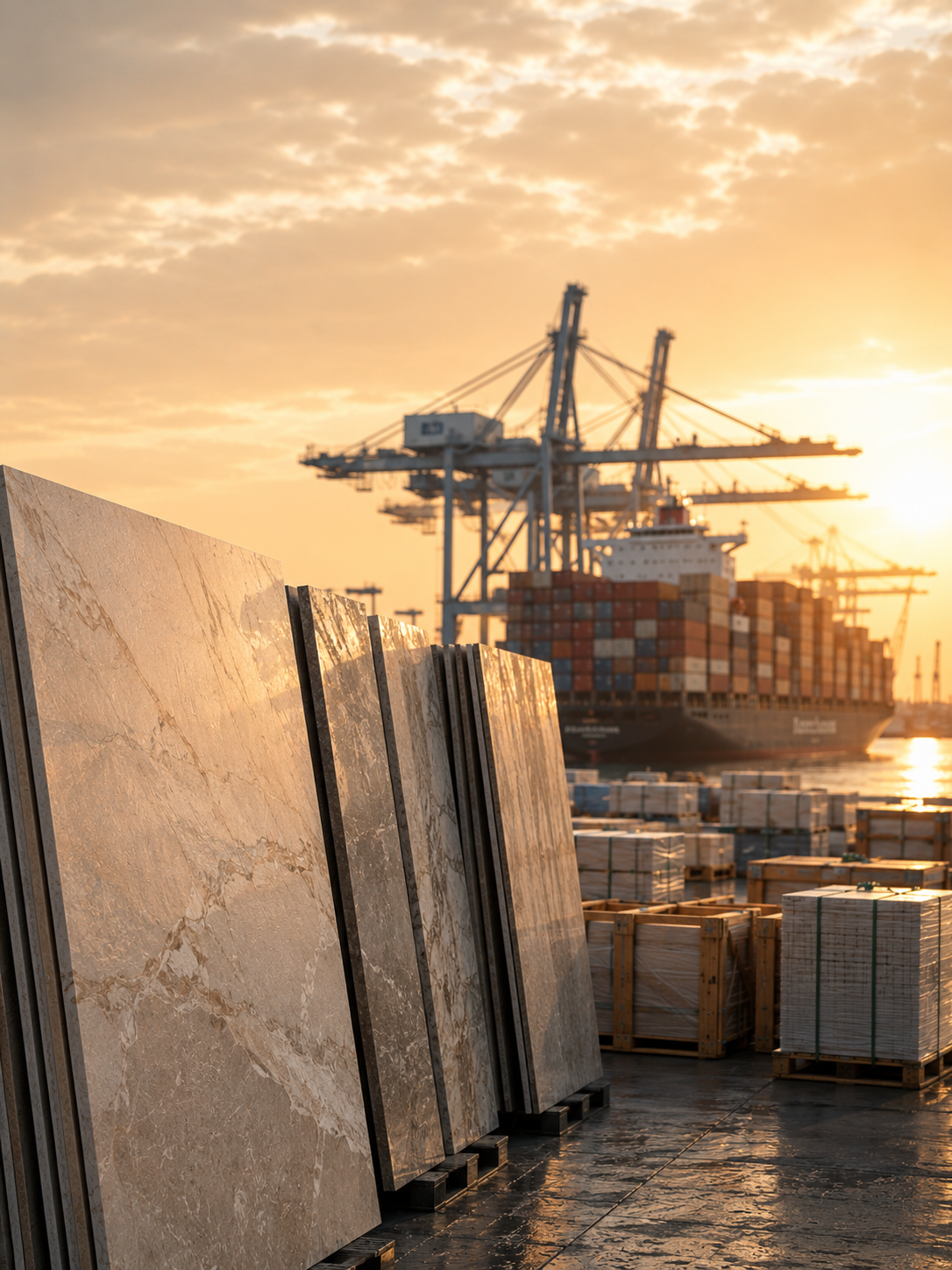
A stone quarried in one country, cut and polished in a workshop in another, packed into a container at a coastal port, and unloaded weeks later at a terminal thousands of kilometres away — the material inside a finished building rarely originates anywhere near the site it finishes. For a long time, that distance was invisible to the people who specified it. A tile was simply available, or it was not; a lead time was simply a number on a purchase order.
That invisibility is gone. In the space of a few disruptive years, the building materials industry has been reminded, repeatedly and expensively, that a container ship diverted around the Cape of Good Hope, a factory closure two time zones away, or a sharp spike in freight rates can move a project's completion date as surely as a change in the drawings. What happens at a port thousands of kilometres away no longer stays there.
For architects, developers and procurement teams who once treated materials sourcing as a design decision, this is a shift in category: sourcing is now a risk to be managed, not a formality to be assumed. The industry that emerges from this period will not be the one that entered it — and understanding why is the first step toward specifying and building with confidence in it.
Concentrated manufacturing, a thinner margin for error
Building materials have always travelled. What has changed is how thin the margin for disruption has become, and how visible that thinness now is to everyone downstream of it.
Manufacturing itself remains concentrated in a small number of hubs. Guangdong's Foshan cluster in China — home to more than 800 manufacturing units — and Gujarat's Morbi cluster in India, which alone accounts for roughly 70% of India's tile output, between them supply the overwhelming majority of the world's ceramic and porcelain tile by volume. Italy's Sassuolo district and Spain's Castellón region produce at a smaller scale but set the pace on design and command a premium price. A tile or slab specified almost anywhere in the world traces back to one of a handful of production regions — which means a regional disruption, whether an energy shortage, a labour action or a raw-material shortfall, has an outsized effect on global supply.
Between factory and site sits shipping, and shipping has spent the past several years demonstrating how much it can absorb before it visibly strains. Suez Canal transit, long the default route between Asian manufacturing and European and Middle Eastern markets, has been disrupted since late 2023 by Red Sea security risk; a meaningful share of vessels now divert around the Cape of Good Hope, adding roughly ten to fourteen days to a voyage that would otherwise be measured in weeks. An estimated 12–15% of global trade, and closer to 30% of Asia–Europe container volume, would ordinarily pass through that corridor — enough that a persistent diversion reshapes vessel scheduling well beyond the routes directly affected.
Diversification — of supplier, of route, of carrier — has moved from contingency planning to baseline discipline. A single origin, a single carrier and a single route are each, individually, a single point of failure.
Freight cost has followed a similarly volatile path: sharp spikes during acute disruption, gradual normalisation as capacity catches up, and a fresh jump whenever a new risk — a canal closure, a strait incident, a seasonal cargo rush — reintroduces uncertainty. A carrier's rate card is no longer a stable input to a cost estimate; it is a variable that can move materially between the day a quotation is issued and the day the container actually sails. Port operations add a further layer: congestion at one major transshipment hub can cascade into delayed vessel calls at destination ports weeks later, while customs and inspection capacity sets a hard ceiling on how quickly cleared cargo actually reaches a regional distributor.
Cape of Good Hope Reroute vs. Suez Canal
Normally Routed via the Red Sea Corridor
Sources: ITF/OECD Red Sea shipping impact analysis; Drewry World Container Index and industry freight-market reporting, 2026.
The journey, stage by stage
However abstract a supply chain sounds in the aggregate, it is, at ground level, a sequence of specific, physical steps — and the more familiar that sequence becomes to the people specifying and buying material, the easier it is to see where delay actually accumulates.
1. Raw Materials
Clay, feldspar, quartz and mineral pigment, quarried or mined and moved to a manufacturing plant that is often itself hundreds of kilometres from the deposit.
2. Manufacturing
Pressed, glazed and fired — at temperatures exceeding 1,000°C for porcelain — on production lines that run continuously for weeks and are themselves sensitive to energy price and availability.
3. Quality Inspection
Dimensional tolerance, calibration between pieces and surface consistency checked against the standard the product is sold against, before a single unit reaches a container.
4. Packaging
Engineered for a six-week sea voyage and multiple forklift transfers — a materially different specification from packaging built for a same-city delivery.
5. Container Shipping
Weeks at sea, on a fixed sailing schedule and, as the previous chapter set out, a route that is no longer as predictable as it once was.
6. Port Operations
Unloading, customs clearance and inspection — a queue often determined by port capacity rather than any individual shipment's urgency.
7. Regional Distribution
Trucking, warehousing and, in many cases, a final consolidation step, carrying material from port to local stockholding or directly to site.
8. Construction Project
The last stage, and the only one most of the industry actually sees — the point at which everything upstream either held, or didn't.
Everything upstream of a construction site exists to make sure that, on the day a contractor needs a specific tile in a specific quantity, it is there. When it is not, the project rarely knows which of the seven prior stages is responsible — which is precisely why understanding the full sequence, not just its final delivery, has become a genuine procurement skill.
“A tile on a construction site is the last stop in a journey that, more often than not, began on another continent entirely.”Petrona Journal · Edition No. 07
Price was never the only variable — now it isn't even the main one
Price was, for a long time, the dominant criterion in a materials procurement decision — reasonably so, when supply was reliable enough that everything else could be assumed. That assumption no longer holds, and procurement practice has changed accordingly.
Lead time has become a specification in its own right, sat alongside colour and finish rather than treated as background logistics. A project programme increasingly works backward from a confirmed shipping and customs timeline rather than a manufacturer's stated production time alone, because the gap between the two has widened. Technical compliance and documentation carry more weight than they once did — not because standards have changed, but because verifying them has become part of de-risking a supplier relationship. A batch's conformity to ISO, ASTM or equivalent testing, and a supplier's ability to produce the paperwork proving it on request, is now assessed alongside price rather than after a problem has already appeared on site.
Stock availability is weighed with unusual seriousness. A supplier holding genuine regional inventory, rather than quoting factory lead time as if it were delivery time, has become materially more valuable — sometimes valuable enough to justify a higher unit price, because the cost of a stalled site is rarely smaller. Supplier reliability and business continuity are now explicit line items in a vendor assessment rather than an implicit assumption; procurement teams increasingly ask a version of the question insurers have always asked — what happens to this order if the supplier's primary factory, primary port or primary shipping lane is disrupted for a month?
A supplier without a credible answer to that question is a different kind of risk than one who has one — and procurement teams have started asking it before it matters, not after.
None of this displaces quality consistency as a criterion — batch-to-batch calibration, colour matching and dimensional accuracy remain non-negotiable for any specification-grade project. What has changed is that quality is now evaluated alongside resilience, not instead of it. The result is a procurement function that looks more like a risk-management discipline than a purchasing one — closer, in practice, to how a business would qualify a critical-path supplier in any other industry.

What experience actually buys a project
An experienced materials supplier earns its position in a specification not by being the cheapest quote on a tender, but by absorbing complexity on a client's behalf — much of it invisible until it is missing.
Technical support is the most direct expression of this: a supplier who can advise on the right specification for a given application, rather than simply fulfilling whatever is ordered, prevents the kind of costly mismatch that shows up only after installation. Reliable stock, held genuinely and not merely quoted, is the difference between a project that proceeds on schedule and one that waits on a vessel. Alternative sourcing — a second qualified factory, a second viable route, a second product that can substitute without compromising the design intent — is a capability that only becomes visible when the primary option fails; its absence is rarely noticed until a project needs it and does not have it.
Documentation and compliance support matters more than its administrative reputation suggests: a supplier able to produce test certificates, conformity statements and batch records promptly, rather than after repeated requests, removes friction from every stage between specification and handover. And consistent quality across repeat orders — the same shade, the same calibration, the same finish, ordered months apart — protects a project's design intent across its full delivery, not just its first shipment.
None of this is exotic. It is, in aggregate, simply what "reliable" means when a project depends on a material arriving from thousands of kilometres away, on schedule, matching a sample approved months earlier. In a supply chain environment defined by disruption, that reliability has become a genuine differentiator — and, increasingly, a genuine specification criterion in its own right.
Where resilience is heading next
None of the forces reshaping this industry are likely to reverse. The more useful question is how the industry adapts — and several trends already point to an answer.
Digital visibility is becoming standard rather than exceptional. Real-time shipment tracking, automated customs documentation and demand-forecasting tools are moving procurement away from a model built on periodic phone calls and toward one built on continuous data — shrinking the gap between a disruption occurring and a project team knowing about it. Early applications of AI-assisted procurement extend this further: forecasting demand against historical and live shipping data, flagging supplier risk before it becomes a shortage, and modelling alternative routes and sourcing scenarios faster than a human planner working from spreadsheets.
Supply chain resilience is increasingly designed in, rather than assumed. Multi-sourcing across more than one manufacturing region, pre-qualifying alternative suppliers before they are needed, and holding strategic regional inventory are shifting from contingency planning to standard practice for any project or supplier operating at meaningful scale. Regional manufacturing and nearshoring are gaining ground for reasons that are as much about resilience as cost: producing closer to demand, or at least maintaining regional finishing, warehousing and distribution capacity closer to end markets, shortens exposure to any single long-haul shipping corridor, even where core raw-material sourcing remains global.
Sustainability considerations are converging with resilience rather than competing with it. Shorter shipping distances reduce emissions and reduce exposure to freight volatility at the same time; more efficient packaging reduces both waste and the breakage that drives costly reordering; and better-calibrated production reduces the material waste that a resilient, well-documented supply chain was already working to prevent for other reasons.
“Resilience is not the opposite of efficiency. It is the condition that makes efficiency durable.”The Petrona Journal · Edition No. 07
None of this suggests the industry is heading toward a simpler supply chain. Global manufacturing concentration, in ceramics and porcelain especially, is not disappearing, and the specialised skill and scale built up in a small number of production regions is not easily replicated elsewhere. What is changing is the sophistication with which the industry manages the distance between those regions and the sites that depend on them — more visibility, more diversification, and more of the operational discipline that, until recently, belonged mainly to industries already forced to learn it the hard way. Building materials is, in effect, catching up to a truth that shipping and freight professionals have understood for years.
Why do building material lead times vary so much right now?
Lead times are shaped by several compounding factors: manufacturing concentration in a small number of global hubs, shipping route disruption such as the Red Sea diversion around the Cape of Good Hope, port congestion, and freight rate volatility. A quoted factory lead time is only one part of the total journey — shipping and port clearance typically add several further weeks.
What is the Red Sea shipping disruption and how does it affect construction projects?
Since late 2023, security risk in the Red Sea has led most container lines to reroute Asia–Europe and Asia–Middle East cargo around the Cape of Good Hope instead of through the Suez Canal, adding roughly ten to fourteen days to affected voyages. Around 30% of Asia–Europe container traffic normally transits the Red Sea corridor, so the diversion has reshaped vessel scheduling and lead-time planning well beyond the routes directly affected.
How should a project team plan procurement given current supply chain volatility?
Build lead time into the project programme as a confirmed shipping and customs timeline, not a factory production estimate alone. Assess suppliers on stock availability, documentation and business continuity alongside price, and favour suppliers who hold genuine regional inventory or can offer a qualified alternative source if the primary one is disrupted.
Is nearshoring a realistic solution for building materials?
Regional manufacturing and nearshoring are gaining ground, particularly for finishing, warehousing and distribution capacity closer to end markets. Core manufacturing scale in ceramics and porcelain remains concentrated in a small number of established global hubs, so nearshoring is best understood as a way to reduce exposure to any single long-haul corridor, not a wholesale relocation of manufacturing.
- ITF/OECD — The Red Sea Crisis: Impacts on Global Shipping and the Case for Coordinated Action. International Transport Forum, Organisation for Economic Co-operation and Development.
- Drewry Shipping Consultants — World Container Index, weekly freight-rate benchmark, 2026.
- Industry manufacturing and export data on global ceramic and porcelain tile production hubs (Foshan, Guangdong; Morbi, Gujarat; Sassuolo, Emilia-Romagna; Castellón), compiled from published trade and industry sources, 2026.